Показаны сообщения с ярлыком Elvira Nabiullina. Показать все сообщения

воскресенье, 4 мая 2025 г.

How Nabiullina, Kostin and Potanin robbed the middle class. Part 3

VTB replaced clients' money with air


The VChK-OGPU Telegram channel and Rucriminal.info publish the final part of the investigation into the most grandiose financial scam in the Russian Federation since the robbery of the people during the USSR.
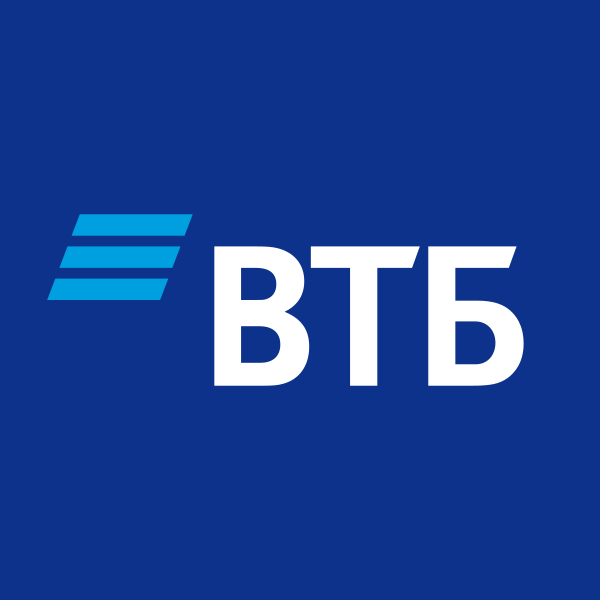


The version with unmarked assets and the blocking of some VTB assets in Euroclear, concocted in the "highbrow" offices of the Central Bank, appealed to them so much as an excuse for the process of exchanging the currency of unsanctioned clients for air that Goryunov simply forgot to read the Rules for Conducting Organized Trading of PAO SPB-Birzha, which clearly states the ban on trading in encumbered assets. But if he keeps referring to blocked assets, then his whole speech is about the fact that in the period from March to May 31, 2022, they actively traded VTB's encumbered assets, having previously replaced the storage locations of liquid assets of unsanctioned brokers on the St. Petersburg Exchange, where assets are traded in US dollars, with illiquid assets of sanctioned brokers on the Moscow Exchange, where securities are traded in rubles, calling the process of replacing money with air, liquidity with illiquidity, and one exchange with another a systemic risk. Let's take a closer look at how and what regulatory documents accompanied these operations. We can start with that very Decision of the Board of Directors of the Bank of Russia dated March 18, 2022. Literally in the very first paragraph, the Central Bank recommends transferring assets of clients of sanctioned banks to depository accounts of non-sanctioned banks in order to "prevent the spread of restrictive measures to their depositors." Moreover, in paragraph 1, the Central Bank notes the need to record the encumbrance or limitation of rights to dispose of such assets. In fact, after this operation of "careful transfer" from point A to point B, VTB investors finally lost access to their assets. These assets exist only in their application on non-trading accounts, just like a candy wrapper that can neither be eaten nor thrown away. At the same time, when issuing depository statements for these assets, not a single bank that has accepted these assets in any way notes the fact of their encumbrance or limitation of rights of use, as the Central Bank recommended them in its Decision of the Board of Directors. Because this would entail serious legal consequences. The decision of the Board of Directors of the Bank of Russia dated March 18, 2022 was preceded by an even more interesting document of the Central Bank, to which, unfortunately, clients of banks and exchanges that were not yet sanctioned at that time did not pay the slightest attention, and, in fact, it was already a signal that Russian exchanges should be immediately abandoned with the withdrawal of assets. We are talking about the Information Letter on a set of measures to support financial market participants No. IN-018-38/28 dated March 6, 2022. In this letter, the Central Bank essentially informs financial market participants, namely brokers, depositories, and investment fund managers, about force majeure and the associated deregulation of the market as such. For example, its most interesting point 8 reads as follows:

“8. The Bank of Russia will refrain from applying enforcement measures against depositories for the following violations until 01.01.2023:

- non-compliance of a foreign organization in which the depository has opened an account of a person acting in the interests of other persons for recording rights to securities represented by Russian depository receipts or to securities of foreign issuers during their public placement and (or) public circulation in the Russian Federation, with the criteria established by Bank of Russia Instruction No. 5311-U12;

Considering the fact that the claim of investors active in the investigations against brokers and the Central Bank was precisely the substitution of the BONY depository for Euroclear in the internal accounting registers of brokers, this letter practically demonstrates the “green light” that Nabiullina gave to broker depositories to solve the problems of both their own and their sanctioned clients by substituting storage locations, actively using the term “unmarked assets”, unknown to Russian laws.

From that moment on, the financial markets of the Russian Federation, in essence, lost regulation. It is impossible to assess the risks in such markets, so any sensible investor should have immediately left them, and not believed the lies of Roman Goryunov, director of the St. Petersburg Exchange, that trading was taking place in an internal pool, and that clients of unsanctioned brokers and banks were not in danger. This was a lie in order to continue exchanging middle-class currency for immobilized or illiquid assets that he would not be able to dispose of from the moment X.

It would be even more correct to pay attention to the timing of the so-called deregulation. In essence, the Central Bank gives market participants until the end of 2022 to replace one foreign organization in which the broker opened an account with another, move client assets from the exchange pool to off-balance sheet accounts and somehow resolve the problems of individuals and organizations that fell under sanctions, and the liquidity problems of the broker banks themselves. The second wave of blocking took place, as mentioned above, on 01.06.2022 in accordance with the Central Bank Order No. 018-38-6/4762 from 05/30/2022 - the same 14%, which turned into 35% for some brokers. From mid-2022, the St. Petersburg Exchange switches to trading Hong Kong securities, but the holiday did not last long, since on November 2, 2023, the St. Petersburg Exchange falls under blocking sanctions of the United States, and all foreign securities in its circuit fall under the final block. Thus, the time cycle of exchanging middle-class currency for air is completed (and many believe that all these agreements with BONY were signed only for this), and already on November 7, 2023, Roman Goryunov, who could compete with Mavrodi, leaves his post and becomes a member of the Board of Directors of the Kazakh trading platform ITS.

"So he ate akyns and saxaul for six months. And nothing - he arrived flabby and with bulging eyes" V. Erofeev "Moscow-Petushki".

However, in the finale it would be more appropriate to quote Nikanor Ivanovich's Dream from "The Master and Margarita".

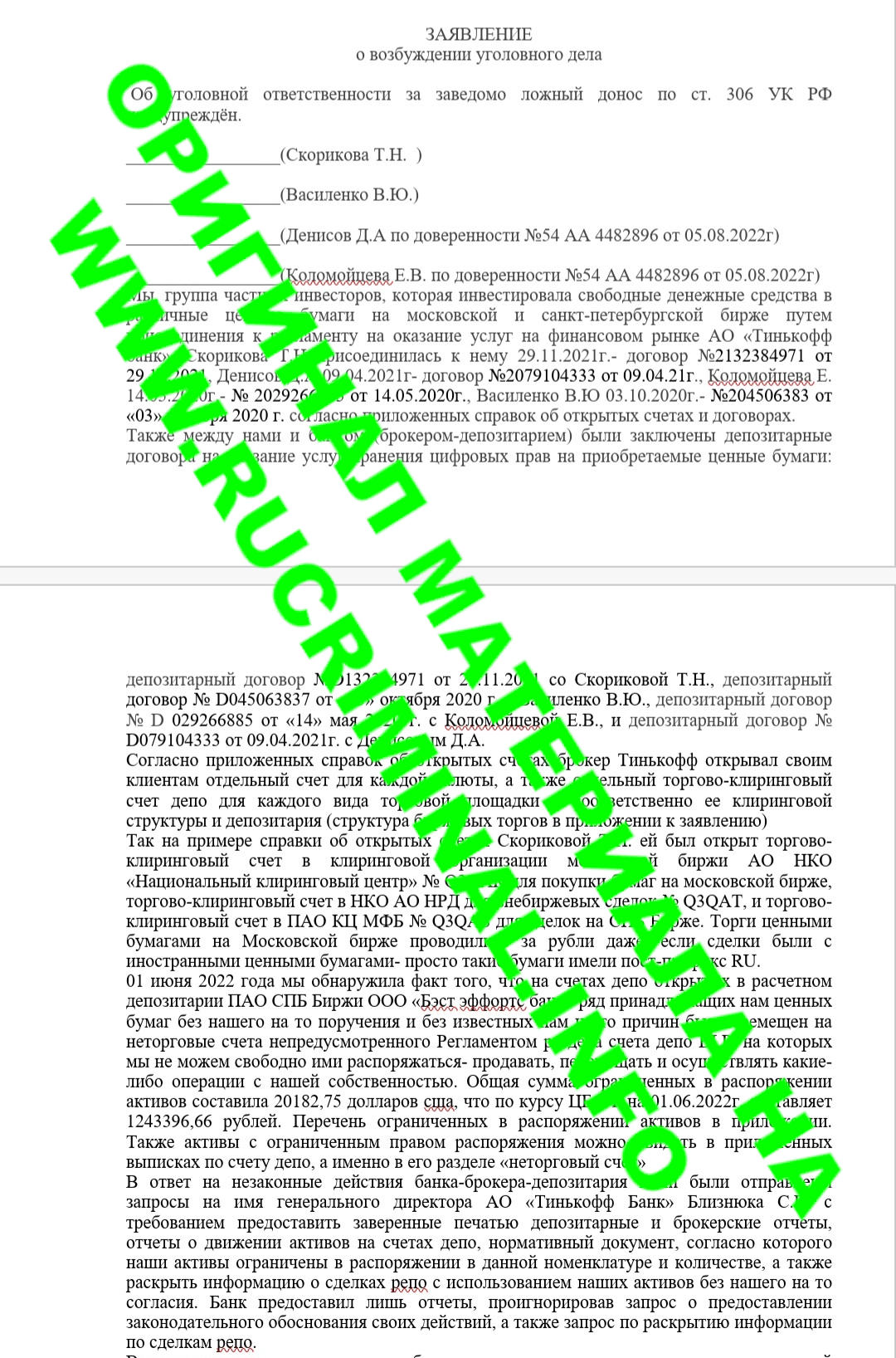
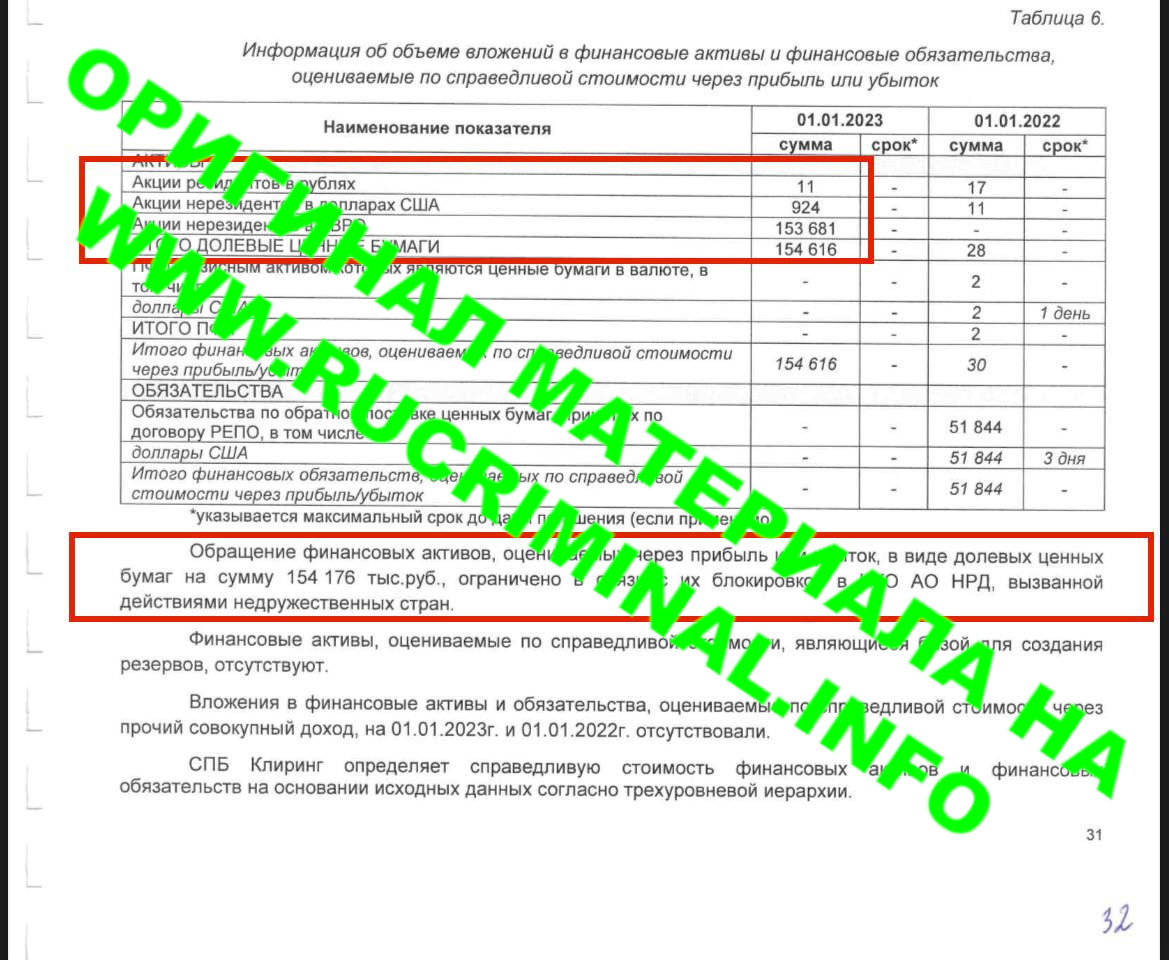
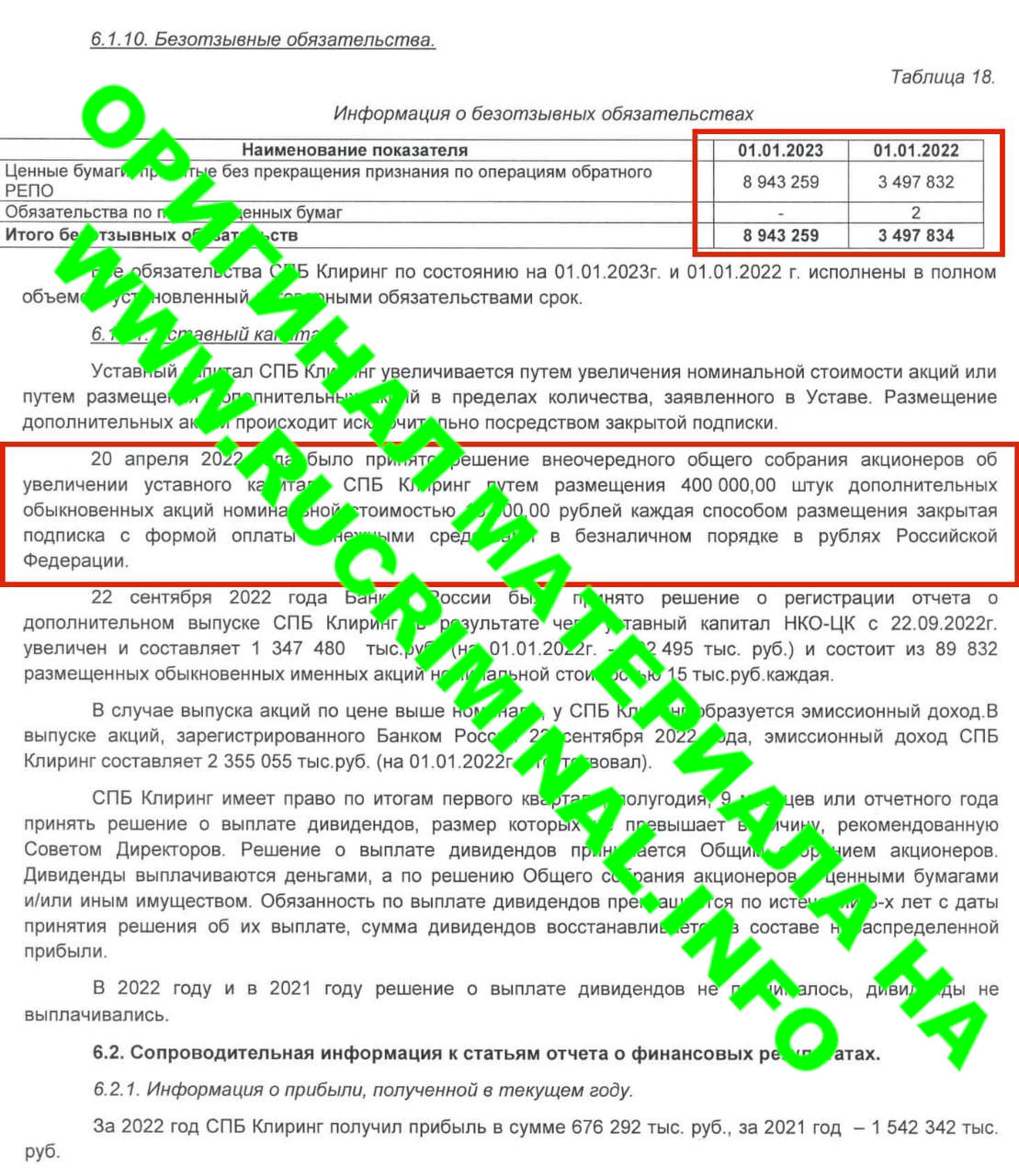
And yes, periodically the Moscow Exchange announces the trading of blocked American shares on the over-the-counter market, where only the brokers themselves or other professional market participants have the right to buy. And here you need to understand that this is not trading shares, this is an attempt by the debtor, that is, the broker, to buy up the debt to a retail investor for half the price. Discounts of less than 50% to the stock exchange value of the share do not happen there. For example, the NVDA share, which on 04/29/25 cost more than $108 on the NYSE, is bought up on the interbank market for no more than four thousand rubles. This is simply an attempt to buy up the debt with a 50% discount and nothing else. Fortunately, money is not life, and Russian investors lost their savings in a much less deplorable situation than Ukrainian citizens. But during the period of fighting with banks, activists faced so many tragic events in life that it is extremely difficult to call them accidents. For example, Natalia Shpurik, who everyone knows from videos exposing VTB, lost her nephew, drugs were planted on the son of another activist Svetlana Mavrinskaya and he was put in prison, another activist Zhanna Borodina began the fight after being cured of cancer, but it returned to her very quickly in the process and she was gone, because she no longer had money for expensive treatment. Another activist had a wheel unscrewed from a car, apparently hoping for an accident. And personally, my life in Crimea was made simply impossible, somehow gaining access to the keys to the house. It does not even make sense to list cats with slit throats thrown under the fence, because these are trifles compared to everything else. After all, you need to understand that the amount of damage caused to Russian citizens only for two "careful transfers" of their assets as of the end of 2022, not counting the final blocking of assets of clients of the St. Petersburg Exchange at the end of 2023, amounted to at least $3.5 billion, and according to Bloomberg estimates - $20 billion. For comparison, Tesla's startup was worth $500 million. That is, with this money it was possible to launch a sea of ​​projects and buy out a lot of enterprises, which is most likely what happened. The catch was too big, the stakes were too high for people who grew up as businessmen in the 90s not to remember ways to shut up particularly loud mouths. And that is why we decided to voice our vision of the situation and even make publicly available a claim against Tinkoff, which, in fact, lists all the legislation of the Russian Federation, according to which the actions of the exchange and the broker were illegal. The statute of limitations expires in May of this year, and there are millions of victims. Perhaps many of them will still reach the courts and perhaps even win their cases, let's wish them luck.


Tatyana Skorikova

To be continued

Source: www.rucriminal.info

How Nabiullina, Kostin and Potanin robbed the middle class. Part 2

Broker "Tinkoff Bank" with the St. Petersburg Exchange took possession of clients’ assets


The VChK-OGPU Telegram channel and Rucriminal.info continue to talk about the most grandiose financial scam in the Russian Federation since the robbery of the people by Sberbank of the USSR.


On May 30, 2022, in the "News" section on the Tinkoff Bank website, a statement was published about the blocking of 14% of the volume of securities traded on the St. Petersburg Exchange, which are stored in NPO JSC NSD and were blocked by Euroclear.


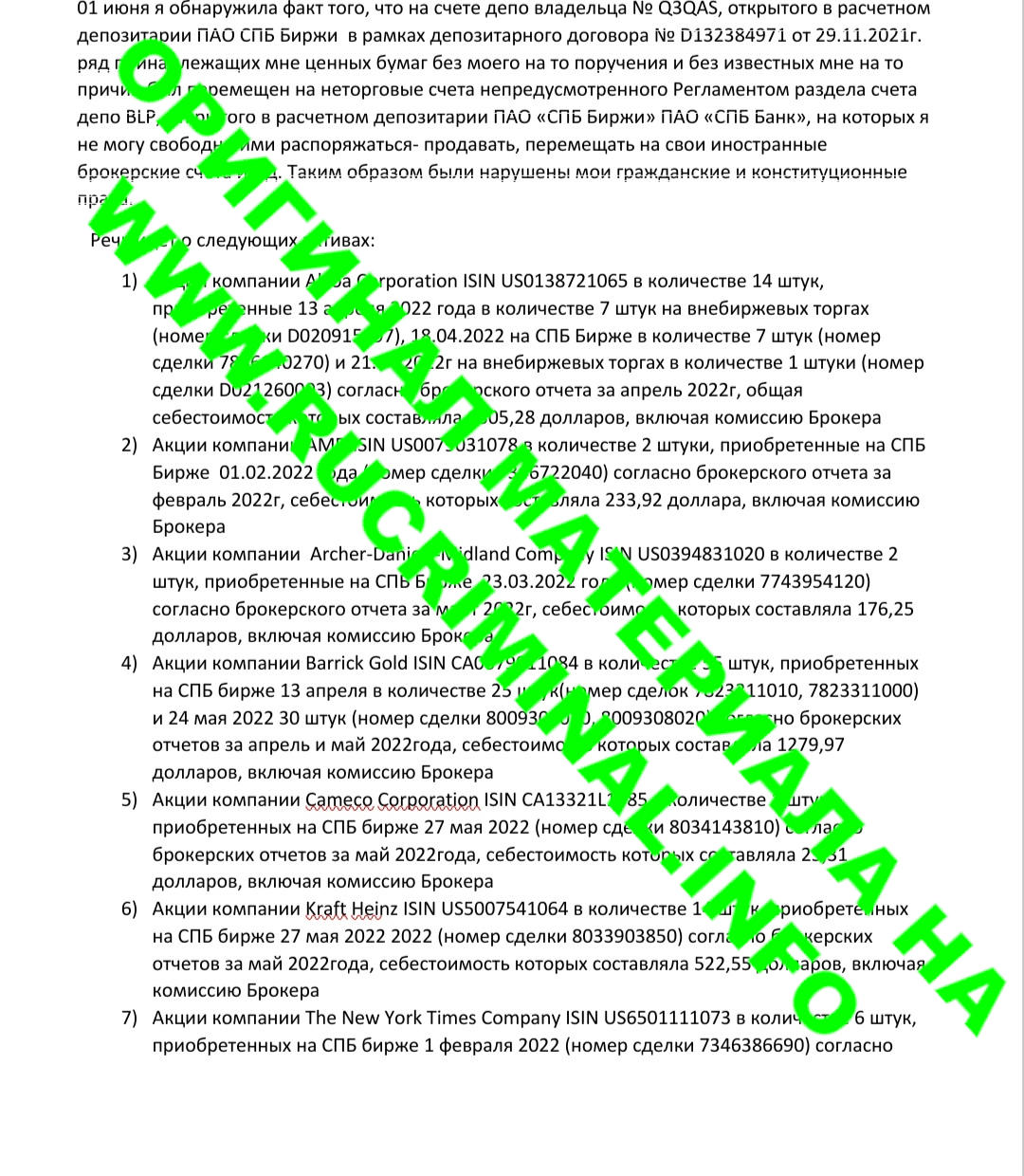
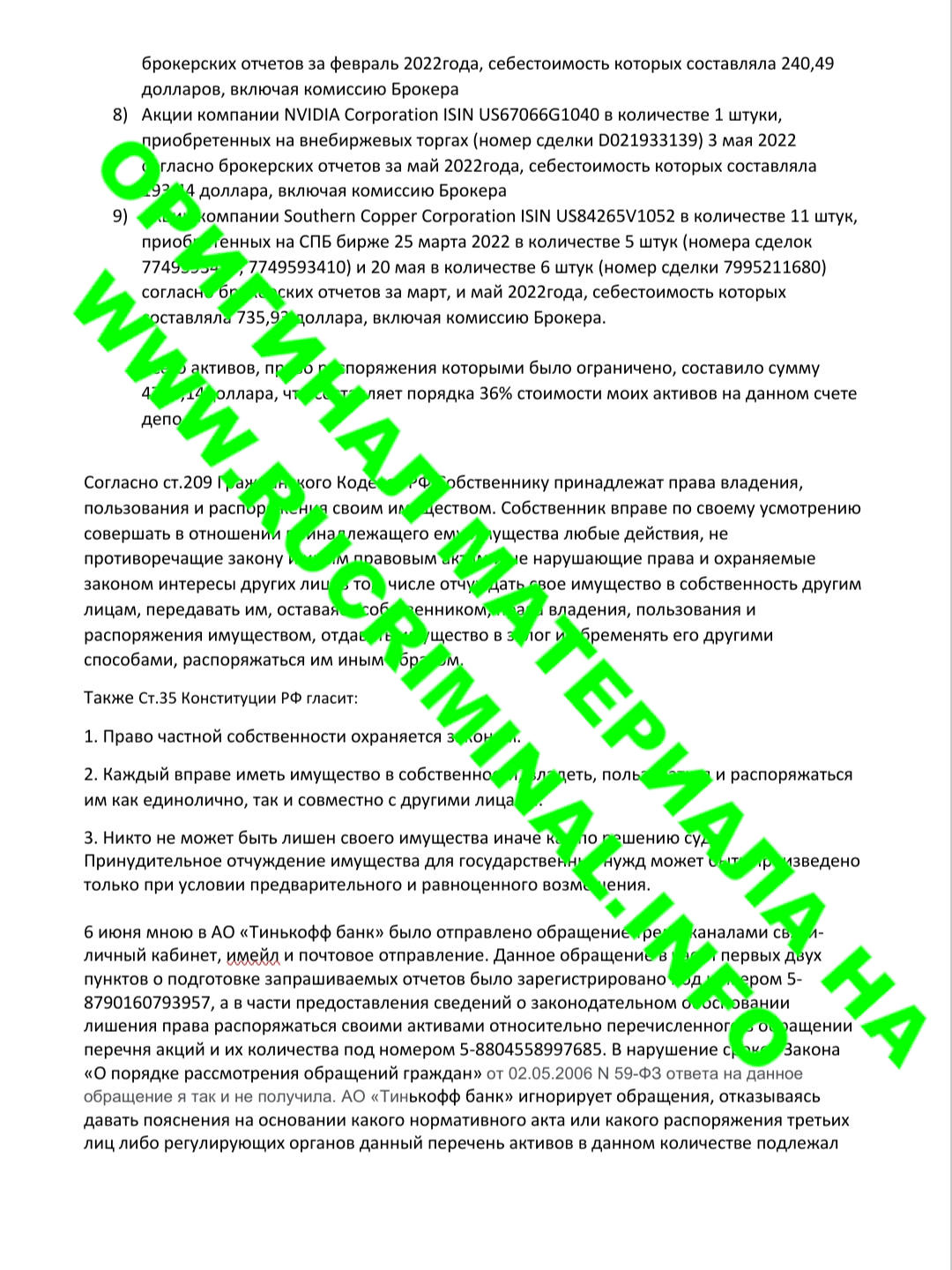
In the case of Tinkoff Bank, the promised 14% of the volume of securities subject to blocking by the Central Bank actually turned into a blocking of an average of 32-33% of all assets of the clients of this broker, which is evident from the attached file of the list of blocked assets of 20 clients of this bank, to whom I provided support in terms of drafting applications to investigative bodies and in claims work.


After multiple requests for documents, Tinkoff Bank responded only to the official claim that the basis for the blocking was the Central Bank's Order No. 018-38-6/4762 dated 05/30/2022 for another "careful transfer".


Despite the fact that as of 30.05.2022, neither Tinkoff broker nor St. Petersburg Exchange were under sanctions from any country, this did not prevent them from citing Euroclear sanctions when blocking, transactions with which had been suspended since the beginning of March 2022.


At the same time, if we open the details of Tinkoff Bank JSC for the transfer of securities of their depositors on page 4, we will see that the transfer of American securities is by default linked to the depository account of St. Petersburg Exchange in the same BONY, to the so-called DTC ID BONY, in which a sub-account was opened for St. Petersburg Exchange structures. The bank did not provide any response to any request for information on depository chains or the submission of analytical accounting statements confirming the presence of blocked securities in NSD and Euroclear.


It is also no coincidence that the purchase date of most of the assets blocked by the broker and the exchange falls on April and May 2022, after the suspension of cooperation between Russian financial institutions and Euroclear. By the end of March 2022, all sanctioned brokers except Sovcombank had transferred their clients' assets to non-trading accounts. And already in April, the process of replacing liquid assets of non-sanctioned brokers with illiquid assets of sanctioned ones began with the help of repo transactions and changing storage locations for them, with the help of debt assignment agreements, and also, possibly, transferring securities of the victims to third-party mutual investment funds, which allowed the broker Tinkoff Bank JSC, in collusion with the structures of the St. Petersburg Exchange, to take possession of the assets of its clients and dispose of them at its own discretion without having any grounds for this and even, unlike VTB, force majeure in the form of sanctions, which can cover up any crime! Indirect evidence of this is the unwillingness of the broker and the St. Petersburg Exchange to disclose, at the request of the victims, both the depository chains of storage locations, and the accounting entries and correspondence of accounts for our assets. They refuse to do this even in court.

Also, if you look at the brokerage reports, an official document that the broker issues according to its Regulations every month, then in section 3.1, where the movement for each type of asset for the month and its market price are indicated, you can see an obvious discrepancy.

In May 2022, in the brokerage reports of Kolomoitseva E.V. and Skorikova T.N. in section 3.1, the price of assets changes currency and becomes ruble instead of dollar, and in the brokerage report of Vasilenko V.Yu. the prices simply disappear. And here it should be noted that on the Moscow Exchange, securities of American companies were quoted in rubles and it was for them that settlements were made through Euroclear. These securities had a separate ticker with the post-prefix RU. On the St. Petersburg Stock Exchange, securities were recorded directly in the US central depository DTC and always had only a dollar value. Therefore, this currency failure in brokerage reports, together with the dazzling repo transactions that the broker carried out independently without the client's consent, confirm the hypothesis of a deliberate change in storage locations.

Suspecting that the assets were appropriated by the broker, a group of investors decided to summarize the data on which assets, from whom and in what percentage of their total amount in the portfolio were blocked.

If you study the files with blockages, you can see that 100% of the portfolio was subject to blocking of shares of certain sectors of the global economy - this is metallurgy (gold, aluminum, copper), this is the military industry and aerospace industry, this is the energy industry and related industries, for example, pipe rolling, as well as companies producing food products, which indirectly indicates the ordered nature of the blocking. These assets could have been transferred by order of Western creditors of the exchange and broker, could have been transferred to the founders in the event of changes in the Authorized Capital, the changes to which took place immediately after the blocking, as can be seen from the Unified State Register of Legal Entities, could have been transferred to third-party investment funds, or were alienated in some other way.

money on someone's specific order. This blocking has too much investor-like good taste!

All these facts were listed in statements to the investigative bodies of the Russian Federation, but, as expected, the bodies did nothing.

At the same time, even if, with all the threads that stick out, without being woven into a beautiful version of the Central Bank and brokers, we believe that the blocking actually took place, and the dollar assets were in the Euroclear contours (which is incredible), then on October 6, 2022, EU Council Regulation 2022/1905 was adopted, which introduced Article 6c into Regulation No. 269/2014. According to this article, the unfreezing of NSD assets is allowed to complete transactions and contracts concluded with NSD before June 3, 2022. The condition for using this exception was the submission of information regarding blocked assets to the EU Ministry of Finance - a list of assets, data on the verification of clients and their beneficiaries and, accordingly, the details for transferring securities to another circuit. In essence, the Belgian Ministry of Finance demanded that beneficiaries be disclosed along the entire depository chain in order to exclude the unblocking of assets of sanctioned persons.

Neither brokers nor the Central Bank did this, nor did they even intend to do so. Therefore, it is difficult not to recall the saying "Was there a boy?"

Instead of the actions requested by Euroclear and the EU Ministry of Finance, the St. Petersburg Exchange and Tinkoff Bank very quickly began to change their statutory documents. After blocking client assets on 31.05.2022, Tinkoff Bank JSC made changes to the authorized capital in the Unified State Register of Legal Entities on June 3. Almost simultaneously with it, on June 3, 2022, changes to the information on the statutory documents were made by NCO CC MC MSE - the clearing company of the SPB Exchange, which just carried out the registration of transactions on the exchange and was responsible for the credit risks of the exchange, changing its name to NCO - CC "SPB Clearing", on June 2, changes to the statutory documents were made by the depository of the SPB Exchange PAO "Best Efforts Bank" renamed to PAO "SPB Bank". And here, given that Tinkoff was the largest holder of investment portfolios in the Russian Federation, the synchronicity of their actions with the exchange itself cannot but arouse curiosity, which cannot yet be satisfied since the Central Bank closed information on changes in the composition of the founders and capital of financial institutions for the time of the SVO. After June 2022, VTB and Tinkoff investors began to unite, conduct investigations, began claims work, correspondence with issuers, deputies. It even came to an attempt at unauthorized access to the Central Bank of the Russian Federation on November 7, 2022, accompanied by an abundance of FSB and FSO officers in the radius along with Rosgvardia vehicles. And already on November 8, 2022, a meeting of activists with Roman Goryunov, director of the St. Petersburg Exchange, took place. The recording of this meeting is one of the most interesting artifacts of this grand financial scam. To begin with, it is worth noting that Roman assumed that only VTB clients would be present at the meeting and did not think that Tinkoff and Freedom Finance clients, who lost access to a significant part of their assets after May 30, 2022, were listening to him. From the second minute, Roman began his stream of sincerity by saying that VTB had disabled everyone's ability to sell (not everyone, as it turned out later) and was closing margin positions, the leverage (credit) for which it gave in a larger volume than it had its own resources, that is, he did this at the expense of the assets of his other clients. This is exactly what Goryunov means when he says at 2.19 minutes that otherwise he would close these margin positions at the expense of the exchange's own resources, which neither the exchange, although it bears the risks of transaction liquidity in accordance with Russian legislation, nor the Central Bank wanted at all. But according to Russian legislation, the obligation to assess the risks of market participants, analyze solvency ratios and cover the risk of participant insolvency lies with the central counterparty of the exchange. In the case of the SPB Exchange, such a central counterparty was NCO CC MCSE, which quickly changed its name on 03.06.22 to NCO-CC "SPB Clearing" on the same day as the changes in the statutory documents of Potanin's Tinkoff Bank! At 3.11 minutes, he goes further and says that even the assets of VTB's own clients were not enough to plug the hole in its finances, and therefore on 30.05.2022 the Central Bank decided to use the assets of clients of other broker banks to help VTB, calling it a 'systemic risk'. In essence, Goryunov openly says that the blocking of assets of clients of Tinkoff, BCS, Freedom Finance and other unsanctioned brokers on 30.05.2022 was carried out in order to plug VTB's financial holes, even though none of these clients had any contractual relations with VTB. In fact, VTB, which decided to use sanctions as force majeure and as a means of depriving its clients of assets, did not meet resistance either in the structures of the St. Petersburg Exchange or in the Central Bank of the Russian Federation itself. In addition to robbing BT's own clients, they also decided to get a little bit of other brokers' assets in order to eventually balance the exchange's clearing center.

At 20:45, a Tinkoff client tells him that he was not sanctioned at the time of blocking on 30.05.

22 Tinkoff broker blocked about 32% of clients' assets instead of the 14% set by the Central Bank. And when trying to sort out with the broker about the disproportionality of the blockings, about why the assets of entire sectors of the economy were subject to 100% blocking, the bank only responded that the managers of the St. Petersburg Exchange brought them a download file with all the transactions and analytics on clients, and they only pressed the "conduct" button. Goryunov confirms this fact, again broadcasting about VTB's debts, which for some reason had to be covered not only by unsanctioned VTB clients, but also by clients of other banks that have no relations with VTB and even with certain assets!.


Tatyana Skorikova

To be continued

Source: www.rucriminal.info

четверг, 1 мая 2025 г.

How Nabiullina, Kostin and Potanin robbed the middle class

Investigation into the main financial scam - PAO "SPB Exchange". Part 1


"Nobody is guilty of anything." Roman Goryunov. Director of PAO "SPB Exchange" It is this quote from Goryunov that best characterizes in a satirical key the narratives of the financial regulator of the Russian Federation regarding the most grandiose financial scam in the Russian Federation since the robbery of the people by Sberbank of the USSR. Details - on the telegram channel VChK-OGPU and Rucriminal.info.

The history of the Russian stock exchange since the transition to a market economy goes back many years, but the financial market really turned around at full capacity in 2021 not only as a result of massive advertising by opinion leaders from Ksenia Sobchak to Artemy Lebedev, loyal info-guardians of any Kremlin policy, but also because on October 21, 2021, the director of the St. Petersburg Stock Exchange Roman Goryunov happily announced direct access to the New York Stock Exchange (hereinafter NYSE) through the custodian bank Bank of New York Mellon (hereinafter BONY), which made it possible to reduce the commission for buying and selling securities to negligible ones.

Despite the fact that not a single financial institution in the Russian Federation had direct access to DTC (the US central depository), and was forced to use the services of several intermediaries, entering the NYSE was actually a breakthrough in terms of access to a huge list of securities and low commissions. The only problem is that the rather low financial literacy of private investors, who were driven to the stock exchange in droves by the above-mentioned influencers, did not allow millions of people to assess the risks. Even if we ignore the risk, which turned out to be the most important and least expected, which will be discussed below, there was not enough literacy even to get enough information about BONY itself, which was associated with many scandals that gave rise to the status of a huge gray bank, and about the St. Petersburg Stock Exchange, not a single annual report of which was audited by the audit company of the Big 4 group. Therefore, this whole deal initially smelled good only for those who made millions on advertising stock markets in the Russian Federation. Nevertheless, 2021 brought huge profits to all securities traders due to the post-pandemic growth of the main US stock indices. Trouble awaited the investor in February 2022 with the start of the so-called special military operation of Russian President Putin. As early as 24.02.2022, full blocking sanctions were imposed on major Russian banks, including VTB Bank, Promsvyazbank and VEB RF. But further we will talk about VTB and Tinkoff banks, since it was their clients who were either completely deprived of access to their assets or were the most numerous victims. As can be seen from the text of the statements of claim in lawsuits with VTB Bank (PJSC), after the introduction of sanctions, VTB Bank (PJSC) had 30 days (from 24.02.2022 to 26.03.2022) to complete all financial transactions, including granting investors the right to sell their foreign securities. However, VTB Bank forcibly closed the opportunity to sell for its clients, citing technical problems from March 1, 2022. Later, VTB Bank sent an information message entitled "Movement of securities for the period from 24.02.2022 to 25.03.2022", which stated that the securities were transferred to the following Counterparty Banks: Alfa Bank JSC and Rosselkhozbank JSC. Brokerage service agreements were automatically concluded with Alfa Bank JSC and Rosselkhozbank JSC without the consent of VTB clients, and the securities owned by right were placed on an over-the-counter ("non-trading") account (section) of third-party banks. (In violation of clause 4.8.4. of the Terms of Depository Activities of VTB Bank PJSC.) It is worth highlighting that we are talking about shares of American companies listed on the NYSE and purchased through the St. Petersburg Exchange, against which no sanctions were imposed until November 2023. These actions to transfer the assets of VTB PJSC were carried out in accordance with the Decision of the Board of Directors of the Central Bank of the Russian Federation dated March 18, 2022, which was motivated by the blocking of assets of sanctioned brokers in Euroclear (the date miraculously coincides with the anniversary of the annexation of Crimea to the Russian Federation, and if we follow the symbolism, then, apparently, the Russian government hinted at the need to pay for the banquet at the expense of the personal funds of the middle class of the Russian Federation)

And then began three long years of endless lies from the head and employees of the Central Bank of the Russian Federation.

We should start with how the Russian stock exchange is structured. There is the Moscow Exchange, where Russian securities are traded, derivatives and debt obligations in euros were traded, as well as foreign securities in ruble valuation. Its activities are supported by the clearing center of the JSCB NCC and its central depository NCO JSC NSD. There is also PAO SPB Exchange, which traded foreign securities in US dollars through direct access to the NYSE. PAO SPB Exchange had a clearing center, OJSC "CC MFB", renamed in June 2022 to NCO CK "SPB Clearing" and a depository, PAO "Best Efforts Bank", renamed in June 2022 to PAO SPB Bank. The sanctions imposed on a broker, for example, VTB, should not have had immediate consequences for its clients, since VTB itself did not have direct contractual relations with European depositories. Contractual relations with the depositories Euroclear and Clearstream were held by the structures of the Moscow Exchange, that is, a depository of a higher order than the VTB depository, namely NSD. This is evident, among other things, from the court cases of Russian banks against Euroclear, for example, the court case of Bank Saint Petersburg, where both NSD and Euroclear were defendants, simply because the Eurobonds that were the subject of the claim were stored in Euroclear through NSD depository accounts. And until the EU Ministry of Finance imposed sanctions on NCO JSC NSD, which happened only on June 3, 2022, nothing prevented VTB Bank from closing its positions on the Moscow and Saint Petersburg Exchanges. It is also worth noting the fact that not a single court case of Russian banks against Euroclear, either in the Russian Federation or in the EU jurisdiction, which can also be found in the registers of court cases of the Russian Federation against Euroclear, concerned any shares, especially those trading on the NYSE. Each such claim dealt exclusively with Eurobonds blocked in EU structures, which indirectly confirms the general falsity of the statements of both brokers and the head of the Central Bank that the American shares of VTB clients blocked in the structures of the St. Petersburg Exchange were blocked in the Euroclear circuit, which they have repeatedly voiced. The exchange itself, obeying the sanctioning authorities, had to withdraw the assets of sanctioned banks from the pool and not have relations with them, so as not to fall under secondary sanctions. And in this case, VTB actually had to either allow clients to sell their shares and forcibly close margin positions (customers' purchase of securities using a broker's loan), or transfer the assets of clients to another unsanctioned broker. The first option is better because it excludes contractual relations between a sanctioned broker and a non-sanctioned one. Clients sold - clients are not under sanctions, no one violated anything. Therefore, Sovcombank acted exactly this way, setting deadlines for its clients for the mandatory sale of all assets.

When transferring, the new broker had to replenish the special account of the Clearing Company of the Joint Venture Exchange with the amount of funds/shares received from VTB and place securities of new clients in its depositories for depository accounting (trading and depository accounts), having checked the absence of sanctions for such new clients, the so-called compliance. But judging by the fact that the new broker placed VTB assets on off-balance sheet non-trading accounts, on which the share valuation is approximately $ 0.01, he did not receive any financial security/liquidity from VTB. This was a transfer of the register of digital rights of clients who no longer had material value from the off-balance sheet account of VTB to the off-balance sheet account of the new broker. The assets of VTB clients were simply zeroed out. It is no coincidence that the attached agreement on the transfer of assets between VTB and Alfa-Bank does not include any figures, as well as the amounts of remuneration for the transaction. Of course, there are additional agreements to them, which neither Kostin nor Fridman will ever show to anyone, even in court!

These dubious operations began to be accompanied by information noise with the emergence of a kind of financial newspeak, which did not appear in any regulatory act of the Russian Federation. Namely, "internal pool", "untagged assets", "seamless transfer", "non-trading accounts". That is, too much vocabulary appeared in the everyday life of the financial regulator, which is not provided for by any legislative act of the Russian Federation in this area. The factor of constraint and the boundaries of what is permissible disappeared in an instant, like a mask falls from a face.

The decision of the Board of Directors of the Central Bank of the Russian Federation dated 18.03.22 on the careful transfer of financial assets of citizens of the Russian Federation from an unknown place to an unknown place was naturally not the last, but only the first of three.


Tatyana Skorikova

To be continued

Source: www.rucriminal.info