четверг, 6 января 2022 г.

"The risk of escaping is too great."

Vladislav Klyushin, who was arrested in the United States, was not released on bail.


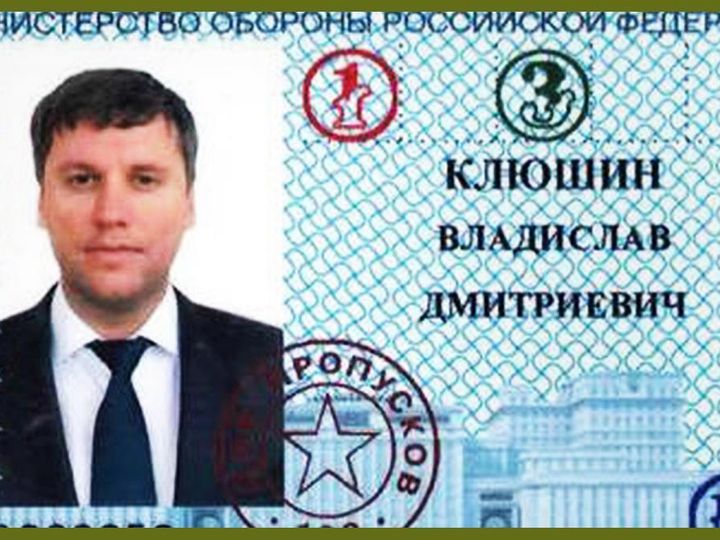
A federal court in Boston today held a hearing on the election of a measure of restraint for Vladislav Klyushin, a Russian who is accused of trading inside information, the founder of M 13, which is developing a media monitoring system for the Kremlin. The meeting was held in the form of a video conference on zoom. See Rucriminal.info for details.


Lawyer Igor Slabykh, who was present at the meeting, said that the process began with a speech by Assistant Prosecutor Stefan Frank. (https://t.me/uslegalnews/1396)

The assistant prosecutor said that Klyushin should not be released from custody, and cited the following as the main argument: “the defendant has no connections at all in the United States - no home, no family, no friends - and nothing keeps him here at all”. Further, in opposition to the prosecutor, Klyushin's lawyer Maxim Nemtsev spoke out. He cited as an example similar court cases in the United States, where the defendants were released on bail.

Also at the meeting, the judge criticized the letters in support of Vladislav Klyushin, which the lawyer attached as a recommendation with a request to release the defendant. We have previously published two examples of such letters - the wife of Klyushin, Zhanetta Klyushina, and the general director of M 13, Alexander Badikov. In addition, similar letters were written by other colleagues and relatives of the defendant.

“The letters do not at all reflect the fact that their authors know the essence of the accusation. All letters start with the same phrases, ”said Judge Marian Bowler. Therefore, the court refused to attach significant weight to the letters with Klyushin's support.

At the meeting, Vladislav Klyushin himself said that he did not admit guilt. The next meeting was scheduled for February.

Interestingly, Klyushin's defense had previously stated that they were ready to secure a bail of $ 2.5 million so that the court would release the accused under house arrest. In addition, the lawyer asked to leave Klyushin in home detention in a one-bedroom apartment building that Mr. Klyushin rents in the seaport area, with permission to leave only for visits to a lawyer and medical appointments with the permission of the pre-trial service. Klyushin also said that he agreed to wear an electronic monitoring device with a global positioning system; Surrender your passport (which is already in the possession of the government); agree not to seek or receive a new passport during the consideration of this case; agree to be extradited to the United States from any country and waive all rights to such extradition; is ready to prohibit any person from entering the residence of Mr. Klyushin, except for Mr. Klyushin and his lawyers, without the prior permission of the pre-trial service and / or the court. Also earlier, Vladislav Klyushin, through lawyers, said that he agreed to refuse to use communications and the Internet and was even ready to hire security guards at his own expense to ensure that he did not run away.

Interestingly, as arguments for sending Klyushin under house arrest, his lawyer also noted earlier: “Mr. Klyushin comes from a poor family. His mother worked as a salesman in a supermarket, gave birth to Mr. Klyushin when she was about 18 years old. Mr. Klyushin is not related to his father, who is not even on the birth certificate. As a child, Mr. Klyushin's family was poor. He started working at 13 to support his family. "

However, the accusation was adamant, among the arguments of the assistant prosecutor was the fact that Vladislav Klyushin very often visited different countries on private planes. The judge agreed that the risk of escape was too great. Klyushin was left in custody.


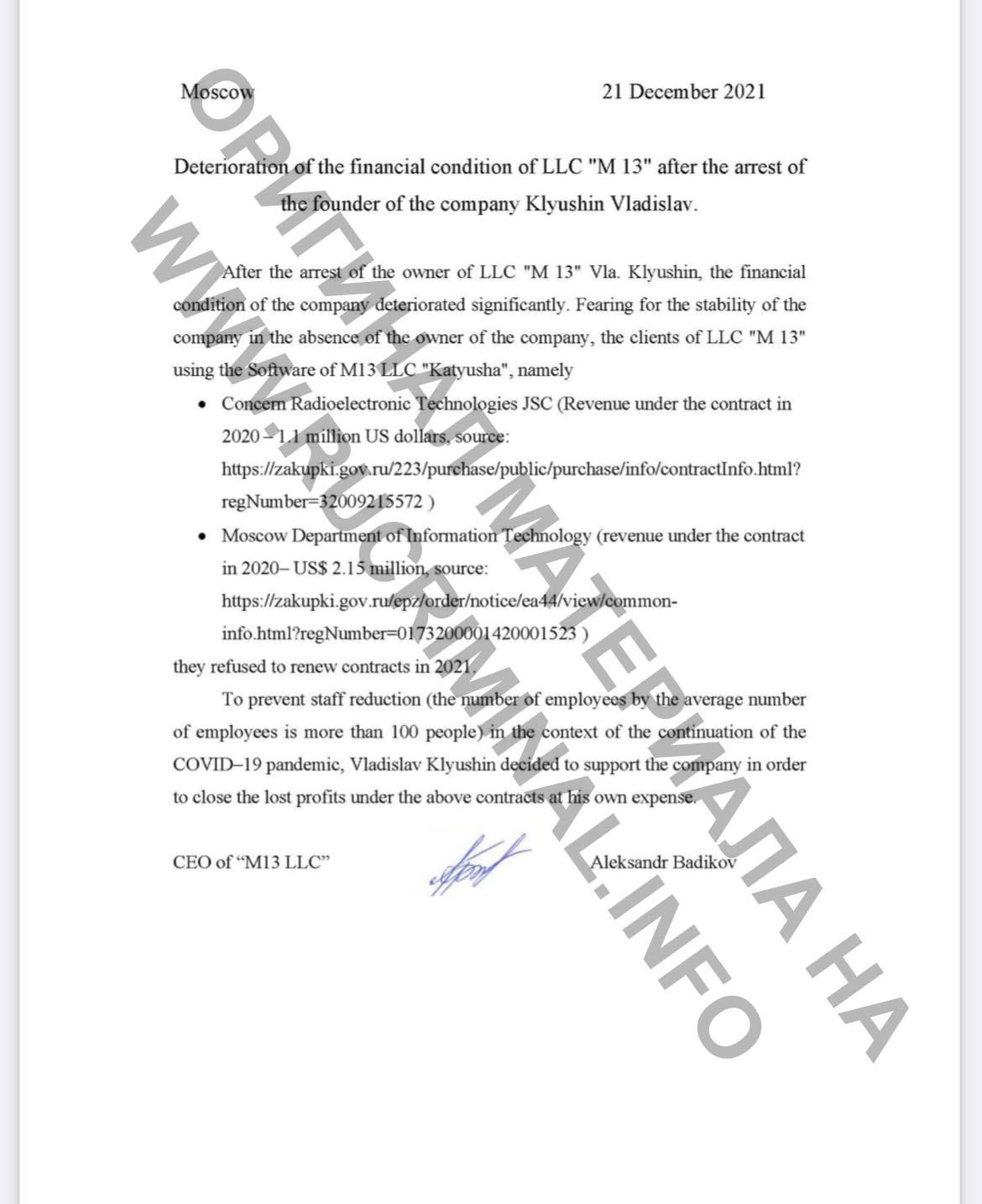
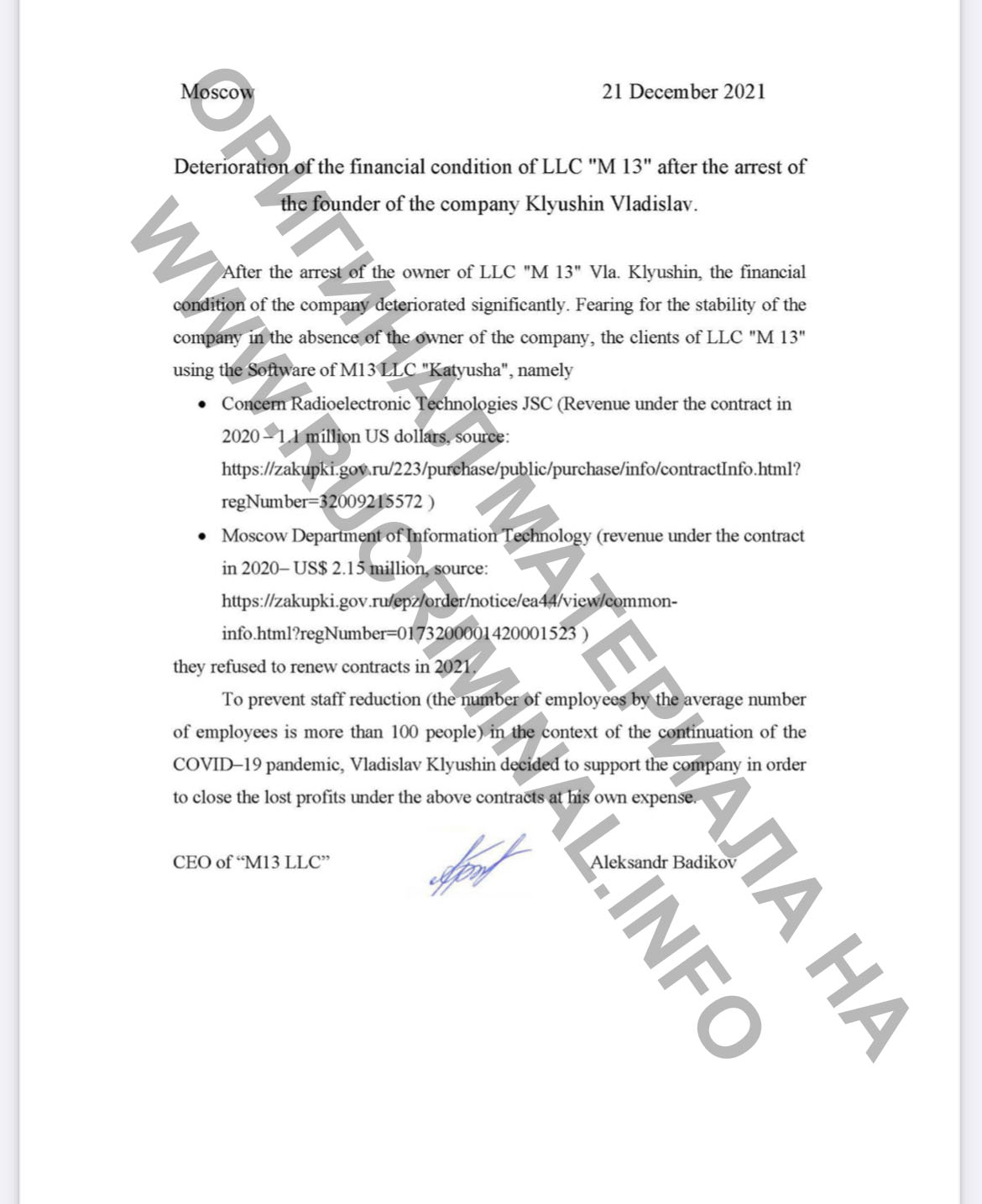
Let us remind you that the letter from the general director of the company Klyushin M-13 Alexander Badikov said that the Rostec Concern and the Moscow Department of Information Technologies had refused the services of the M 13 company.

“After the arrest of the owner of LLC“ M 13 ”Vladislav Klyushin, the financial condition of the company has deteriorated significantly. Fearing for the stability of the company in the absence of the owner of the company, clients of LLC M 13 using the M13 software of LLC Katyusha, namely: • LLC Concern Radioelectronic Technologies (Contract revenue in 2020 - 1.1 million US dollars, and the Moscow Department of Information Technology (contract revenue in 2020 - 2.15 million US dollars refused to renew contracts next year, ”reads a letter from M 13 CEO Alexander Badikov, which is at the disposal of Rucriminal.info.


Gleb Ivankov

To be continued

Source: www.ruciminal.info


«Риск побега слишком велик»

Арестованного в США Владислава Клюшина не стали отпускать под залог.


В федеральном суде в Бостоне сегодня прошло судебное заседание об избрании меры пресечения обвиняемому в торговле инсайдерской информацией россиянину Владиславу Клюшину, основателю фирмы «М 13», разрабатывающий систему мониторинга СМИ для Кремля. Заседание проходило в виде видео-конференции по зуму. Подробности у Rucriminal.info.

Юрист Игорь Слабых, который присутствовал на заседании, сообщал, что начался процесс с выступления помощника прокурора Стефана Франка. (https://t.me/uslegalnews/1396)


Владислав Клюшин


Помощник прокурора заявил, что Клюшина нельзя отпускать из под стражи, и в качестве главного аргумента привёл следующее: «у подсудимого нет вообще никаких связей в США - ни жилья, ни родных, ни друзей - и здесь его совсем ничего не держит». Далее в противовес прокурору выступил адвокат Клюшина Максим Немцев. Он привёл в пример подобные судебные дела в США, где подсудимых отпускали под залог.

Также на заседании судья раскритиковал письма в поддержку Владислава Клюшина, которые адвокат приложил в качестве рекомендательных с просьбой освободитель подсудимого. Мы уже ранее публиковали два примера таких писем - супруги Клюшина Жанетты Клюшиной и генерального директора «М 13» Александра Бадикова. Кроме того, подобные письма написали другие коллеги и родные подсудимого.

«Письма совсем не отражают того, что их авторы знают суть обвинения. Все письма начинается с одинаковых фраз», - заявила судья Мариан Боулер. Поэтому суд отказался придавать значительный вес письмам с поддержкой Клюшина.

На заседании сам Владислав Клюшин заявил, что не признаёт вину. Следующее заседание назначили на февраль.

Интересно, что ранее защита Клюшина уже заявляла, что они готовы обеспечить залог в размере 2,5 млн долларов, чтобы суд отпустил обвиняемого под домашний арест. Кроме того, адвокат просил оставить Клюшина на домашнем содержании под стражей в жилом доме с одной спальней, который г-н Клюшин арендует в районе морского порта, с разрешением выезда только для посещения адвоката и медицинских приемов с разрешения службы предварительного производства. Также Клюшин заявил, что согласен носить электронное устройство мониторинга с глобальной системой позиционирования; Сдать свой паспорт (который уже находится в распоряжении правительства); согласен не искать и не получать новый паспорт во время рассмотрения этого дела; согласен на экстрадицию в США из любой страны и отказ от всех прав на такую ​​экстрадицию; готов запретить любому лицу входить в резиденцию г-на Клюшина, кроме г-на Клюшина и его адвокатов, без предварительного разрешения службы предварительного производства и / или суда. Также ранее Владислав Клюшин через адвокатов заявил, что согласен отказаться от использования связи и интернета и даже готов за свой счёт нанять охранников, которые следили бы, чтобы он не сбежал.

Интересно, что в качестве аргументов для отправления Клюшина под домашний арест его адвокат ранее также отмечал: «Г-н Клюшин происходит из небогатой семьи. Его мать работала продавцом в супермаркете, родила г-на Клюшина, когда ей было примерно 18 лет. Г-н Клюшин не связан со своим отцом, которого даже нет в свидетельстве о рождении. В детстве семья г-на Клюшина была бедной. Он начал работать в 13 лет, чтобы обеспечивать семью».

Однако обвинение было непреклонно, среди доводов помощника прокурора прозвучало и то, что Владислав Клюшин очень часто посещал разные страны на частных самолетах. Судья согласился, что риск побега слишком велик. Клюшина оставили под стражей.


Напомним, что письме генерального директора компании Клюшина «М-13» Александра Бадикова говорилось, что от услуг компании «М 13» отказались Концерн «Ростеха» и Департамент информационных технологий Москвы.

«После ареста владельца ООО «М 13» Владислава Клюшина, финансовое состояние компании значительно ухудшилось. Опасаясь за устойчивость компании в отсутствие собственника компании, клиенты ООО «М 13», использующие Программное обеспечение М13 ООО «Катюша», а именно • ООО «Концерн Радиоэлектронные Технологии» (Выручка по договору в 2020 г. - 1,1 млн долларов США, и Департамент информационных технологий Москвы (выручка по контракту в 2020 г.- 2,15 млн $ США отказались продлевать контракты в следующем году», - говорится в письме генерального директора «М 13» Александра Бадикова, которое есть в распоряжении Rucriminal.info.


Глеб Иваньков

Продолжение следует

Источник: www.ruciminal.info

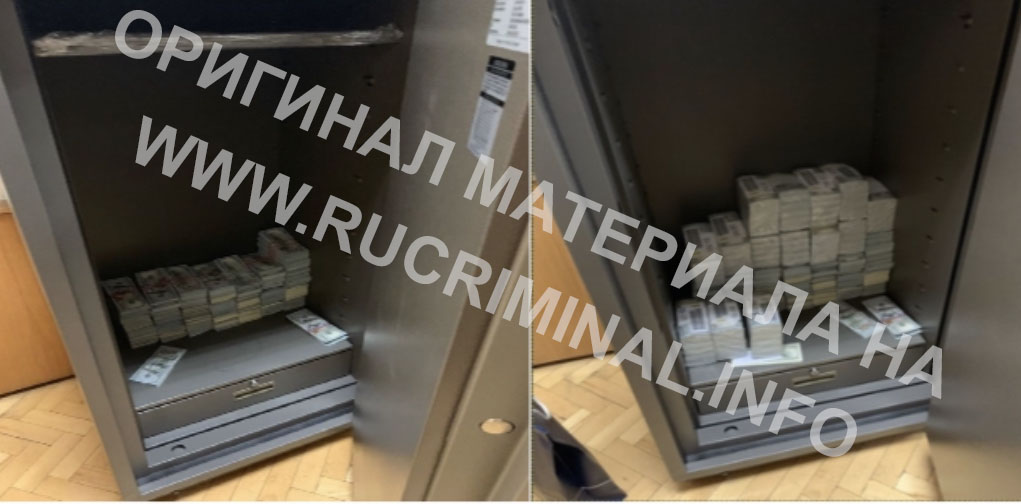
"The location of the safe filled with $ million was never identified by the FBI."

Rostec and the Moscow government got scared by the US and refused to cooperate with Klyushin


As it became known to the VChK-OGPU telegram channel and Rucriminal.info, the Rostec Concern and the Moscow Information Technology Department refused the services of the M 13 company, which belongs to Vladislav Klyushin, who is under arrest in the United States.


This was stated by the general director of the company, Alexander Badikov. He wrote about the situation in detail in a letter to the American court in the case of his colleague and company founder Vladislav Klyushin, who was arrested in the United States on suspicion of trading insider information. From the letter, dated December 21, it follows that M 13, which developed the Katyusha media monitoring system for the Presidential Administration of Russia, is suffering multimillion-dollar losses after the company's founder was arrested.


“After the arrest of the owner of LLC“ M 13 ”Vladislav Klyushin, the financial condition of the company has deteriorated significantly. Fearing for the stability of the company in the absence of the owner of the company, clients of LLC M 13 using the M13 software of LLC Katyusha, namely: • LLC Concern Radioelectronic Technologies (Contract revenue in 2020 - 1.1 million US dollars, and the Moscow Department of Information Technology (contract revenue in 2020 - 2.15 million US dollars refused to renew contracts next year, ”reads a letter from M 13 CEO Alexander Badikov, which is at the disposal of Rucriminal.info.


The Concern Radioelectronic Technologies Joint Stock Company (KRET) is a part of the State Corporation Rostec. KRET unites more than 70 enterprises engaged in the development and production of radio-electronic products.


In 2020 alone, M 13 signed contracts for 355 million rubles in public procurement. In January last year, the company signed another government contract for monitoring media, instant messengers and social networks for the presidential administration and government.


The letter was written as an attachment to the request of Klyushin's lawyers to change his measure of restraint to house arrest. According to the general director of M 13, the company's losses confirm that it is better for Klyushin to be free. Support letters for the accused were also written by his wife, colleagues and friends.


“I’m ready to hire a security company that will make sure that I don’t run away to Russia”


A meeting of the federal court in Boston to decide on the measure of restraint for Vladislav Klyushin was scheduled for January 3. Then the hearing began by zoom, but the judge suddenly postponed the hearing to January 5 at one o'clock in the afternoon local time. Reason: the defendant's lawyer did not submit documents for representation of interests.


However, the defense of Vladislav Klyushin was as ready as possible for the hearing on January 3: almost two dozen pages of the defendant's lawyer explained why the founder of M 13 should be sent under house arrest for the duration of the investigation. As arguments, the decency of the defendant, many children (two from the current wife and three from the former), the willingness to pay a million-dollar bail, as well as almost a dozen letters with sureties from Klyushin's colleagues, wife and friends are also indicated.


“Respectfully, the defense maintains that there are conditions of release that could reasonably guarantee the attendance of Mr. Klyushin. Mr. Klyushin does not have a passport, and the Russian consulate has confirmed that it will not issue any travel documents to Mr. Klyushin during the consideration of this case, "Vladislav Klyushin's lawyer Maxim Nemtsev wrote to the American court.


In addition, the lawyer cites in detail similar examples from the American court proceedings, when the accused were sent home and suggests doing the same with Klyushin:


“For example, in United States v. Seng, 15-cr-706-VSB (SDNY), the court released a Chinese citizen with no ties to the United States, who could not be extradited from China if he fled, and had enormous wealth (including private jets) provided, inter alia, that he is hiring a private security company to monitor him and ensure that he appears in court. Mr. Seng remained on bail for about two years, did not miss any court appearances, and was even allowed to stay in his apartment after being convicted in court and awaiting sentencing, "said Maksim Nemtsev, lawyer for Vladislav Klyushin. ...


Further, the lawyer of the Russian says that he contacted the firm that guarded the aforementioned Chinese citizen. This is Guidepost Solutions, which also has an office in Boston. The company turned out to be ready to provide Mr. Klyushin with the same round-the-clock monitoring services, of course, at his expense. Lawyer Maxim Nemtsev also noted that Guidepost Solution mainly employs former law enforcement officers who have the training and experience to keep an eye on Klyushin and prevent him from fleeing to Russia. Whether to leave the Russian in custody, or to listen to the arguments of the lawyer and release Vladislav Klyushin for the duration of the investigation, the court must decide on January 5 at 1 pm local time. (9 pm Moscow time ).


Bloomberg: Vladislav Klyushin had access to secret documents of the GRU


Recently, Bloomberg sources reported that Russian businessman Vladislav Klyushin, extradited to the United States from Switzerland, who is accused of earning money from the sale of illegally obtained insider information, had access to secret documents in Russia. In particular, according to the publication, Klyushin had access to the data of the Main Directorate of the General Staff of the Russian Armed Forces. And also to the documents related to the hacking of the servers of the Democratic Party during the US presidential elections in 2016.


The hacking, according to the newspaper, was organized by a GRU-affiliated team called Fancy Bear or APT28. If the documents, to which Russian Vladislav Klyushin has access, are in the hands of the United States, they will for the first time be able to provide the United States with documentary evidence that Russia influenced the 2016 elections, according to Bloomberg sources.


Klyushin's lawyer said that before his arrest, his client refused to cooperate with the US and UK special services. "The FBI considered him a person who could have confidential information or state secrets," said the lawyer.


Could Ilya Sachkov surrender Vladislav Klyushin?


According to one of the unconfirmed versions discussed in the media, Vladislav Klyushin's rival, Ilya Sachkov, who was arrested in Moscow on suspicion of treason, could allegedly have handed over Vladislav Klyushin to the American authorities.

In particular, the same Bloomberg claimed that it was Ilya Sachkov who allegedly provided the US authorities with information about a group of hackers of the Russian military intelligence GRU, which in the States was called Fancy Bear, and its attempts to "influence the presidential elections" in the United States in 2016.


This is what ultimately allegedly led to US sanctions against senior GRU officials and the indictment of 12 of its alleged employees.


Interestingly, charges in the case of Vladislav Klyushin in the United States were also brought against Ivan Ermakov, Igor Sladkov, Nikolai Rumyantsev and Mikhail Irzak. At the same time, the US authorities consider Ermakov to be a GRU officer who allegedly personally took part in the interference in the US elections in 2016.


"They didn't hide much": Photo of a safe with millions of dollars and correspondence in instant messengers.


According to the FBI, Klyushin and his partners illegally obtained access to the data with the statements of large companies at the moment when the statements had already been submitted to the regulator or the vendor of the regulator, but had not yet been published. They sold the data with this information to their clients - they traded stocks profitably based on Klyushin's data. Brokerage and bank accounts around the world were used to trade stocks.


As evidence, FBI agents cite numerous correspondence between the accused and their partners. In particular, businessmen often discussed the purchase of expensive real estate or sent each other incriminating photos. For example, a photo of a safe with millions of dollars in cash, which Klyushin sent to friends in instant messengers as a boast.


The location of the FBI safe has never been established.


In addition, the FBI claims that Klyushin and his colleagues were engaged in illegal trading in securities from the same IP-addresses from which they carried out their work in "M 13". Here is what the FBI agent, who personally conducted the investigation, writes about it:


“Based on my review of the historical domain records and my review of the records collected during this investigation, I learned that the Google account and Hotmail account associated with RUMIANTCEV are listed under the domain registrant section M-13.112. Based on open source analysis, I know that the second IP address 89 points to canmos [.Jru ("Canmos"), which appears to be a Moscow-based ISP in Russia. <...> I found out that KLYUSHIN, ERMAKOV and RUMYANTSEV used the Second IP-address 89 to access certain resources of the Technological Company in the period from November 2018 to September 2020. RUMIANTSEV did this around November 28, 2018. six days after Second IP 89 was used to access the Namecheap account associated with the Neumann account, ”the FBI official wrote in the indictment.


The FBI agent further notes that the Neumann account was used for illegal access to information on securities.


Do traces of fraud lead to ex-vice president of Rosneft Eduard Khudainatov?


As Rucriminal.info previously wrote, Boris Varshavsky, Alexander Borodaev and Sergey Uryadov appear in the indictment among Klyushin's customers, to whom he sold information about company shares. If you google these names, it turns out that Varshavsky is the ex-minister of industry and natural resources of the Republic of Khakassia, Alexander Borodaev is the former owner of Ore Khakassia, and Sergei Uryadov is the general director of a financial services, investment and audit company - Avilex ( Avilex).


Borodaev and Varshavsky are close business partners with the former vice president of Rosneft, Eduard Khudainatov. Back in 2017, together they created a coal processing company Colestar LLC.


According to lawyers, theoretically, all businessmen, commissioned by the accused Klyushin and his partners, if they are found guilty, can become accomplices in the crime. However, no charges have been brought against Varshavsky or Borodaev yet.


It is also not known whether Varshavsky and Borodaev worked for higher-ranking customers. According to the FBI, Klyushin and his partners have helped businessmen earn tens of millions of dollars.


Gleb Ivankov


To be continued

Source: www.rucriminal.info

«Местоположение сейфа, набитого млн $ ФБР так и не установили»

Ростех и правительство Москвы испугались США и отказались от сотрудничества с Клюшиным


Как стало известно телеграм-каналу ВЧК-ОГПУ и Rucriminal.info, от услуг компании «М 13», которая принадлежит находящемуся под арестом в США Владиславу Клюшину, отказались Концерн «Ростеха» и Департамент информационных технологий Москвы.

Об этом заявил генеральный директор фирмы Александр Бадиков. О ситуации он подробно написал в письме в американский суд по делу своего коллеги и учредителя компании Владислава Клюшина, который арестован в США по подозрению в торговле инсайдерской информацией. Из письма, которое датировано 21 декабря, следует, что «М 13», разработавшая для Администрации президента России систему мониторинга СМИ «Катюша», после ареста основателя компании, терпит многомиллионные убытки.

«После ареста владельца ООО «М 13» Владислава Клюшина, финансовое состояние компании значительно ухудшилось. Опасаясь за устойчивость компании в отсутствие собственника компании, клиенты ООО «М 13», использующие Программное обеспечение М13 ООО «Катюша», а именно • ООО «Концерн Радиоэлектронные Технологии» (Выручка по договору в 2020 г. - 1,1 млн долларов США, и Департамент информационных технологий Москвы (выручка по контракту в 2020 г.- 2,15 млн $ США отказались продлевать контракты в следующем году», - говорится в письме генерального директора «М 13» Александра Бадикова, которое есть в распоряжении Rucriminal.info.


Акционерное общество «Концерн Радиоэлектронные технологии» (КРЭТ) входит в состав Государственной корпорации «Ростех». КРЭТ объединяет более 70 предприятий, занимающихся разработкой и производством радиоэлектронной продукции.


Только за 2020 год «М 13» заключила на госзакупках контрактов на 355 млн рублей. В январе прошлого года компания заключила еще один госконтракт на мониторинг СМИ, мессенджеров и соцсетей для администрации президента и правительства.


Письмо было написано в качестве приложения к прошению адвокатов Клюшина об изменении ему меры пресечения на домашний арест. По мнению гендиректора «М 13», убытки компании подтверждают, что Клюшину лучше находиться на свободе. Письма в поддержку обвиняемого написали также его жена, коллеги и друзья.


«Готов нанять охранную компанию, которая будет следить, чтобы я не сбежал в Россию»


Заседание федерального суда в Бостоне по решению вопроса о мере пресечения Владиславу Клюшину было назначено на 3 января. Тогда заседание началось по зуму, однако внезапно судья перенесла заседание на 5 января в час дня по местному времени. Причина: адвокат обвиняемого не подал документы на представление интересов.


Однако защита Владислава Клюшина была максимально готова к заседанию и 3 января: почти на двух десятков листов адвокат обвиняемого объяснял, почему основателя «М 13» стоит на время следствия отправить под домашний арест. В качестве аргументов указывается и добропорядочность подсудимого, много детей (двое от нынешней супруги и трое от бывшей), готовность выплатить миллионный залог, а также почти десяток писем с поручительствами коллег, жены и друзей Клюшина.


«С уважением, защита утверждает, что существуют условия освобождения, которые могли бы разумно гарантировать явку г-на Клюшина. У г-на Клюшина нет паспорта, и российское консульство подтвердило, что оно не будет выдавать г-ну Клюшину никаких проездных документов во время рассмотрения этого дела», - пишет американскому суду адвокат Владислава Клюшина Максим Немцев.


Кроме того адвокат подробно приводит похожие примеры из американского судопроизводства, когда обвиняемых отправляли домой и предлагает точно также поступить с Клюшиным:


«Например, в деле United States v. Seng, 15-cr-706-VSB (SDNY), суд освободил гражданина Китая, не имевшего связей с США, который не мог быть экстрадирован из Китая в случае его бегства и имел огромные богатство (включая частные самолеты) при условии, в частности, что он нанимает частную охранную компанию для наблюдения за ним и обеспечения его явки в суд. Г-н Сенг оставался под залогом в течение примерно двух лет, не пропустил ни одну явку в суд, и ему даже разрешили остаться в своей квартире после того, как он был осужден на суде и ожидал приговора», - заявил адвокат Владислава Клюшина Максим Немцев.


Далее адвокат россиянина рассказывает, что связался с фирмой, которая охраняла вышеупомянутого гражданина Китая. Это фирма Guidepost Solutions, у которой также есть офис в Бостоне. В компании оказались готовы предоставить г-ну Клюшину те же услуги круглосуточного мониторинга, конечно же, за его счёт. Адвокат Максим Немцев также отметил, что в Guidepost Solution в основном работают бывшие сотрудники правоохранительных органов, которые имеют подготовку и опыт, чтобы следить за Клюшиным и не дать ему скрыться в Россию. Оставить ли россиянина под стражей, или прислушаться к доводам адвоката и отпустить Владислава Клюшина на время следствия, суд должен решить 5 января в час дня по местному времени. (9 вечера по Москве).


Bloomberg: Владислав Клюшин имел доступ к секретным документам ГРУ


На днях источники издания Bloomberg сообщили, что экстрадированный в США из Швейцарии российский бизнесмен Владислав Клюшин, которого обвиняют в заработке на торговле незаконно полученной инсайдерской информацией, имел доступ к секретным документам в России. В частности, по данным издания, Клюшин имел доступ к данным Главного управления Генштаба ВС России. А также к документам, связанным со взломом серверов Демократической партии во время выборов президента США в 2016 году.


Взлом, по данным издания, организовала связанная с ГРУ команда, которую назвали Fancy Bear или APT28. Если документы, к которым имеет доступ россиянин Владислав Клюшин, окажутся в руках США, они впервые смогут дать США документальные доказательства того, что Россия повлияла на выборы 2016 года, считают источники Bloomberg.


Адвокат Клюшина заявлял, что до ареста его подзащитный отказался сотрудничать со спецслужбами США и Великобритании. «ФБР считало его человеком, который мог обладать конфиденциальной информацией или государственной тайной», — сказал адвокат.


Мог ли Владислава Клюшина сдать Илья Сачков?


Илья Сачков


По одной из неподтвержденных версий, обсуждаемых в СМИ, сдать Владислава Клюшина американским властям якобы мог его конкурент - арестованный в Москве по подозрению в госизмене директор Group IB Илья Сачков.

В частности, тот же Bloomberg утверждал, что именно Илья Сачков якобы предоставил властям США данные о группе хакеров российской военной разведки ГРУ, которую в Штатах назвали Fancy Bear, и ее попытках «повлиять на президентские выборы» в США в 2016 году.


Именно это в итоге якобы привело к санкциям США в отношении высших должностных лиц ГРУ и предъявлению обвинения 12 его предполагаемым сотрудникам.


Интересно, что обвинения по делу Владислава Клюшина в США предъявлены также Ивану Ермакову, Игорю Сладкову, Николаю Румянцеву и Михаилу Ирзаку. Ермакова при этом власти США считают офицером ГРУ, который якобы лично принимал участие во вмешательство в выборы в США в 2016 году.


«Особо не скрывались»: Фото сейфа с миллионами долларов и переписки в мессенджерах.


По версии ФБР, Клюшин и его партнёры незаконно получали доступ к данным с отчетностью крупных компаний в тот момент, когда отчетность уже была сдана регулятору или вендору регулятора, но еще не опубликована. Данные с этой информацией они продавали своим клиентам - те выгодно торговали акциями на основе данных Клюшина. Для торговли акциями использовались брокерские и банковские счета по всему миру.

В качестве доказательств агенты ФБР приводят многочисленные переписки обвиняемых и их партнеров. В том числе бизнесмены часто обсуждали покупку дорогой недвижимости или пересылали друг-другу компрометирующие фото. Например, фото сейфа с миллионами долларов наличными, которую Клюшин в качестве хвастовства отправлял друзьям в мессенджерах.


Местоположение сейфа ФБР так и не установили.


Кроме того, в ФБР утверждают, что Клюшин и его коллеги занимались незаконной торговлей ценными бумагами с тех же самых IP-адресов, с которых они осуществляли трудовую деятельность в «M 13”. Вот что об этом пишет агент ФБР, который лично проводил расследование:


«На основе моего обзора исторических записей домена и моего обзора записей, собранных в ходе этого расследования, я узнал, что учетная запись Google и учетная запись Hotmail, связанные с RUMIANTCEV перечислены в разделе о регистранте доменной записи M-13.112. На основании анализа с открытым исходным кодом мне известно, что второй IP-адрес 89 указывает на canmos [.Jru («Canmos»), который, по всей видимости, является московским провайдером интернет-услуг в России. <…> Я узнал, что КЛЮШИН, ЕРМАКОВ и РУМЯНЦЕВ использовали Второй IP-адрес 89 для доступа к определенным ресурсам Технологической компании в период с ноября 2018 года по сентябрь 2020 года. РУМИАНЦЕВ сделал это примерно 28 ноября 2018 года. через шесть дней после того, как Второй IP-адрес 89 был использован для доступа к учетной записи Namecheap, связанной с учетной записью Neumann», - пишет сотрудник ФБР в обвинительном заключении.


Далее агент ФБР отмечает, что учетная запись Neumann использовалась для незаконного доступа к информации о ценных бумагах.


Следы махинаций ведут к экс- вице-президенту «Роснефти» Эдуарду Худайнатову?


Эдуард Худайнатов (слева) и Борис Варшавский


Как уже ранее писал Rucriminal.info, среди заказчиков Клюшина, которым он продавал информацию об акциях компаний, в обвинительном заключении фигурируют: Борис Варшавский, Александр Бородаев и Сергей Урядов. Если погуглить эти фамилии, выяснится, что Варшавский - экс-министр промышленности и природных ресурсов Республики Хакасия, Александр Бородаев - бывший владелец «Руды Хакасии», а Сергей Урядов - генеральный директор компании, занимающейся финансовыми услугами, инвестициями и аудитом - «Авилекс» (Avilex).


Бородаев и Варшавский - близкие бизнес-партнёры с бывшим вице-президентом «Роснефти» Эдуардом Худайнатовым. Ещё в 2017 вместе они создали компанию по переработке угля ООО «Коулстар».


По мнению юристов, теоретически, все бизнесмены, по заказу которых работали обвиняемый Клюшин и его партнёры, если их признают виновными, могут стать соучастниками преступления. Тем не менее, ни Варшавскому, ни Бородаеву обвинений пока не предъявлено.


Работали ли Варшавский и Бородаев по заказу более высокопоставленных заказчиков, также не известно. По данным ФБР, Клюшин и его партнёры помогли бизнесменам заработать десятки миллионов долларов.


Глеб Иваньков

Продолжение следует

Источник: www.rucriminal.info

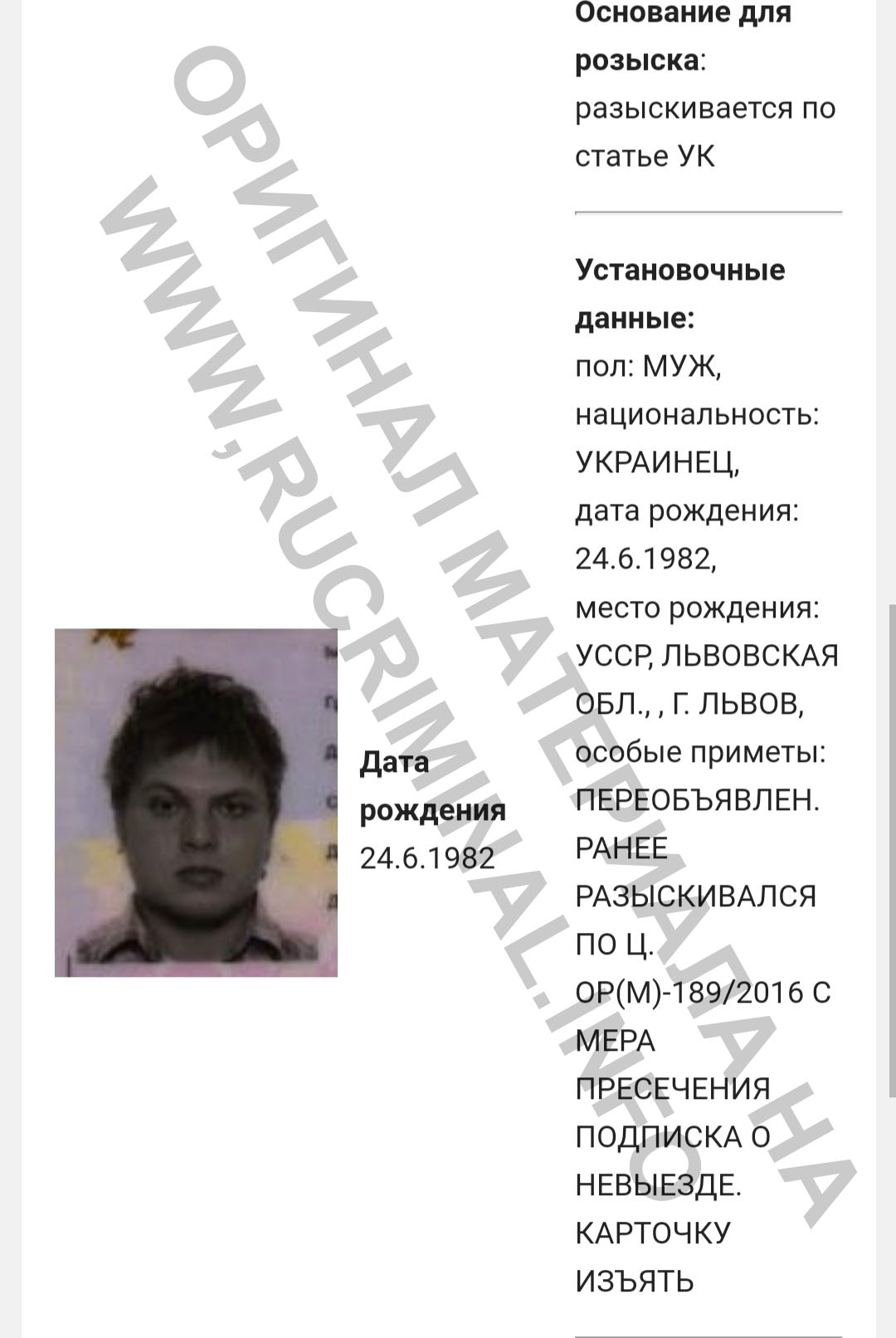
Ukrainian "star" forced Russian students to take microloans

We tell you why the main director of Odessa was arrested in Italy


In Naples, Italy, at the request of Russia, the chief director of the Odessa National Academic Opera and Ballet Theater Yevgeny Lavrenchuk was detained. A court in Naples chose a measure of restraint for the man in the form of detention pending consideration of the Russian extradition request. As the VChK-OGPU telegram channel found out, Yevgeny Lavrenchuk, arrested in Italy at the request of Russia, is accused in absentia under Part 3 of Article 159 of the Criminal Code of the Russian Federation (fraud). The case is being processed by the Department of Internal Affairs of the Central Administrative District of Moscow. Back in 2016, Lavrenchuk was put on the interstate wanted list with a preventive measure not to leave. In 2020, the Tagansky Court of Moscow granted the investigation's motion for the arrest of Lavrenchuk in absentia. Then he was put on the international wanted list. Rucriminal.info managed to get acquainted with the materials of the case against Lavrenchuk and now we are familiar with them to our readers. In short, the essence of the scam incriminated to Lavrenchuk was as follows.

The Polish Theater in Moscow headed by him was actively involved in educational activities. The management of the theater, under the pretext of carrying out repairs in the classrooms in order to resume the educational process, asked the students to take microloans, the guarantee of the return of which was personally Lavrenchuk. The students were promised that the Polish Theater would promptly repay all microloans. The money went directly to a company associated with Lavrenchuk, and then to the accounts of the Polish Theater in Moscow. This theater eventually went bankrupt, the microloans were not repaid, after which the structure that provided them filed claims against the students and Lavrenchuk. Lavrenchuk himself left Russia, the students filed an application with the Internal Affairs Directorate of the Central Administrative District, where a case was initiated under Article 159 of the Criminal Code of the Russian Federation (fraud).

And now Rucriminal.info provides excerpts from the criminal case.

“From the decree of the investigator of the 2nd department of the MCh of the Internal Affairs Directorate for the Central Administrative District of the Main Directorate of the Ministry of Internal Affairs of Russia for Moscow, Major of Justice E.N. Levina to initiate a criminal case and accept it for production on 03.11.2015, it appears that in February 2014, the management of ZAO Polish Theater in Moscow (PTvM), under the pretext of carrying out repairs in the theater, knowingly not intending to fulfill their obligations, applied to the students of this institution with a proposal to sign loan agreements with the MFO "Creation and Development of New Technologies" (SOT). The students, misled, signed the documents presented by the theater management, after which the MFO “Creation and Development of New Technologies” by payment order transferred the funds to the theater’s current account opened with OJSC “Alfa-Bank”, while the obligations of CJSC “PTvM” to return money funds to students under the loan agreement did not fulfill, disposing of the funds received at its own discretion….

From the materials of the criminal case, it follows that by the decision of the investigator of the 2nd department of the MCh SU ATC for the Central Administrative District of the Main Directorate of the Ministry of Internal Affairs of Russia in Moscow, Lieutenant of Justice A.V. Bezukh from 21.03.2016 Lavrenchuk E.V. brought as a defendant in this criminal case, he was charged with committing a crime under Part 3 of Art. 159 of the Criminal Code of the Russian Federation, from which it follows that Lavrenchuk E.V., being the general director of CJSC PTvM, acting out of selfish motives, in an unspecified period of time, but no later than 2014, developed a criminal plan to steal money from students at CJSC "PTvM", by misleading the latter about their criminal intentions, informed the latter about the need to obtain microloans from LLC "Microfinance Organization" Creation and Development of New Technologies ", allegedly for carrying out repair work in the premises of CJSC" PTvM ". Realizing his criminal intent, he (Lavrenchuk E.V.), being at his workplace at an unspecified time by the investigation, but no later than 2014, prepared a microloan agreement between the General Director Shlychkov D.A. and students who were trained at PTvM CJSC on the basis of an agreement for the provision of paid services. In accordance with the specified microloan agreement, LLC MFO SONT provides students with a loan for a period of 36 months by non-cash transfer of the specified loan amount from the settlement account of LLC MFO SONT, opened in LLC Dil-Bank, to the settlement account of CJSC PTvM, opened in OJSC "Alfa-Bank". Having been misled, the students who were not aware of the criminal intentions of E.V. Lavrenchuk, being at PTvM CJSC, entered into microloan agreements with LLC MFO SONT, being fully convinced by E.V. Lavrenchuk. in the absence of the need to return the funds received under the specified microloan agreements.

Continuing his criminal intent, in order to create the appearance and the possibility of returning the funds received Lavrenchuk E.The. concluded in the presence of students an agreement of surety of an individual, as well as an agreement of surety of a legal entity (CJSC PTvM) from, which are security under a microloan agreement. On the same day, cash received on the basis of a payment order to the settlement account of CJSC "PTvM", after which Lavrenchuk E.The. disposed of the received funds at his own discretion, subsequently did not return the funds to the students, did not return the student loan in violation of the agreements reached, having stolen them, that is, he committed a crime under Part 3 of Article 159 of the Criminal Code of the Russian Federation.

Timofey Grishin

To be continued

Source: www.rucriminal.info

Украинская «звезда» заставила студентов РФ брать микрозаймы

Рассказываем, за что в Италии арестован главный режиссер Одессы


В итальянском Неаполе по запросу России был задержан главный режиссер Одесского национального академического театра оперы и балета Евгений Лавренчук. Суд в Неаполе избрал мужчине меру пресечения в виде содержания под стражей на период рассмотрения российского экстрадиционного запроса. Как выяснил телеграм-канал ВЧК-ОГПУ, Евгений Лавренчук, арестованный в Италии по запросу России, заочно обвиняется по ч.3 статьи 159 УК РФ (мошенничество). Дело находится в производстве УВД ЦАО Москвы. Еще в 2016 году Лавренчук был объявлен в межгосударственный розыск с мерой пресечения подписка о невыезде. В 2020 году Таганский суд Москвы удовлетворил ходатайство следствия о заочном аресте Лавренчука. Тогда же он был объявлен в международный розыск. Rucriminal.info удалось ознакомиться с материалами дела в отношении Лавренчука и теперь мы знаком с ними своих читателей. Если коротко, то суть инкриминируемой Лавренчуку аферы заключалась в следующем.


Евгений Лавренчук


Возглавляемый им Польский театр в Москве активно занимался образовательной деятельностью. Руководство театра под предлогом проведения ремонта в учебных помещениях для возобновления учебного процесса попросило студентов взять микрозаймы, поручителем возврата которых выступал лично Лавренчук. Студентам было обещано, что Польский театр оперативно погасит все микрозаймы. Деньги напрямую шли фирме, связанной с Лавренчуком, а потом на счета Польского театра в Москве. Этот театр в итоге обанкротился, микрозаймы погашены не были, после чего, предоставившая их структура, обратилась с исками к студентам и Лавренчуку. Сам Лавренчук уехал из России, студенты подали заявление в УВД ЦАО, где было возбуждено дело по ст 159 УК РФ (мошенничество).

А теперь Rucriminal.info приводит выдержки из уголовного дела.

«Из постановления следователя 2-го отдела СЧ СУ УВД по ЦАО ГУ МВД России по г. Москве майора юстиции Е.Н. Левиной о возбуждении уголовного дела и принятии его к производству от 03.11.2015 года усматривается, что в феврале 2014 года руководство ЗАО «Польский театр в Москве» (ПТвМ) под предлогом проведения ремонта в театре, заведомо не намереваясь выполнять взятые на себя обязательства, обратилось к студентам указанного учреждения с предложением подписать договоры займа с МФО «Создание и освоение новых технологий» (СОНТ). Введенные в заблуждение студенты, подписали представленные руководством театра документы, после чего МФО «Создание и освоение новых технологий» платежным поручением перечислило денежные средства на расчетный счет театра, открытый в ОАО «Альфа-Банк», при этом обязательства ЗАО «ПТвМ» по возврату денежных средств перед студентами по договору займа не выполнило, распорядившись полученными денежными средствами по своему усмотрению….

Из материалов уголовного дела следует, что постановлением следователя 2-го отдела СЧ СУ УВД по ЦАО ГУ МВД России по г. Москве лейтенанта юстиции А.В. Безух от 21.03.2016 года Лавренчук Е.В. привлечен в качестве обвиняемого по данному уголовному делу, ему предъявлено обвинение в совершении преступления, предусмотренного ч. 3 ст. 159 УК РФ, из которого следует, что Лавренчук Е.В., являясь генеральным директором ЗАО «ПТвМ», действуя из корыстных побуждений, в неустановленный период времени, но не позднее 2014 года, разработал преступный план с целью хищения денежных средств обучающихся в ЗАО «ПТвМ», путем введения последних в заблуждение относительно своих преступных намерений, сообщил последним о необходимости получить микрозаймы в ООО «Микрофинансовая организация «Создание и освоение новых технологий» якобы для проведения ремонтных работ в помещениях ЗАО «ПТвМ». Реализуя свой преступный умысел, он (Лавренчук Е.В.), находясь на своем рабочем месте в неустановленное следствием время, но не позднее 2014 года, подготовил договор микрозайма между генеральным директором Шлычковым Д.А. и студентами, которые проходила обучение в ЗАО «ПТвМ» на основании договора на оказание платных услуг. В соответствии с указанным договором микрозайма ООО МФО «СОНТ» предоставляет студентам заем сроком на 36 месяцев путем безналичного перечисления указанной суммы займа с расчетного счета ООО МФО «СОНТ», открытого в ООО «Дил-Банк», на расчетный счет ЗАО «ПТвМ», открытый в ОАО «Альфа-Банк». Будучи введенными в заблуждение студенты, не осведомленные о преступных намерениях Лавренчука Е.В., находясь в ЗАО «ПТвМ», заключили с ООО МФО «СОНТ» договора микрозайма, будучи в полной мере убежденными Лавренчуком Е.В. в отсутствие необходимости возврата полученных денежных средств по указанным договорам микрозайма.

В продолжении своего преступного умысла, с целью создания видимости и возможности возврата полученных денежных средств Лавренчук Е.В. заключил в присутствии студентов договор поручительства физического лица, а также договор поручительства юридического лица (ЗАО «ПТвМ») от, являющихся обеспечением по договору микрозайма. В этот же день, денежные средства поступили на основании платежного поручения на расчетный счет ЗАО «ПТвМ», после чего Лавренчук Е.В. распорядился полученными денежными средствами по своему усмотрению, студентам денежные средства впоследствии не вернул, заем за студентов в нарушение достигнутых договоренности не возвратил, похитив их, то есть совершил преступление, предусмотренное ч.3 ст.159 УК РФ».


Тимофей Гришин

Продолжение следует

воскресенье, 2 января 2022 г.

"After receiving the envelope, the person can be immediately" worked out ", that is, killed"

How the prosecutor ordered the murder of the investigator. His wife, the judge, was also hit by the ...


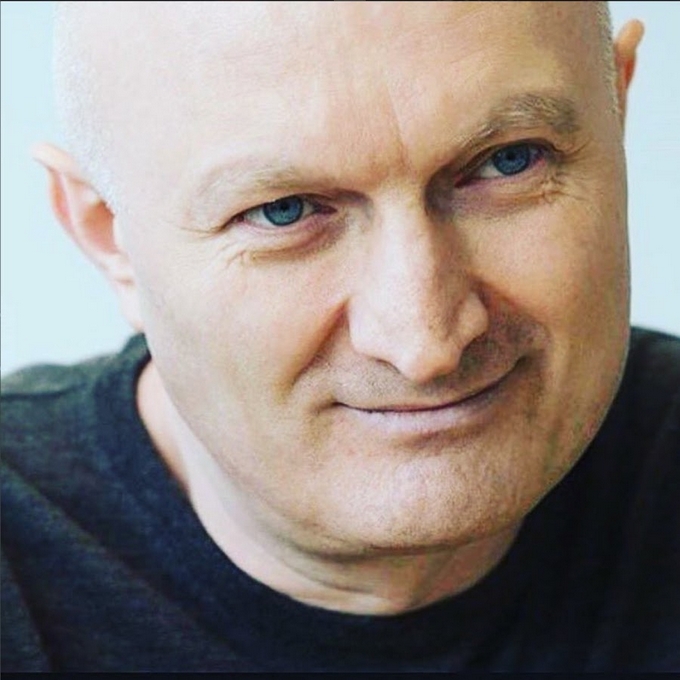
The Moscow City Court postponed until January 11, 2022 the hearings in the case against the form prosecutor of the Zaterechny district Olga Shvetsova. She is charged with contract murder. According to the investigation, the prosecutor appealed to the "authority" Aslan Gagiev (Dzhako) to kill the investigator of the Moscow Interdistrict Investigation Department for Transport Alexander Leonov. The reason is everyday conflict. Earlier, Leonov was married to his sister Shvetsova and they had a very difficult divorce with the division of property. Shvetsova turned to Gagiev for help, and he decided to tie himself up with the prosecutor with "blood" and gave the order to the killers to eliminate Leonov. The investigator was killed in the west of Moscow on September 12, 2012. That evening, he was returning home with his common-law wife, the judge of the Savelovsky District Court, Tatyana Adamova.
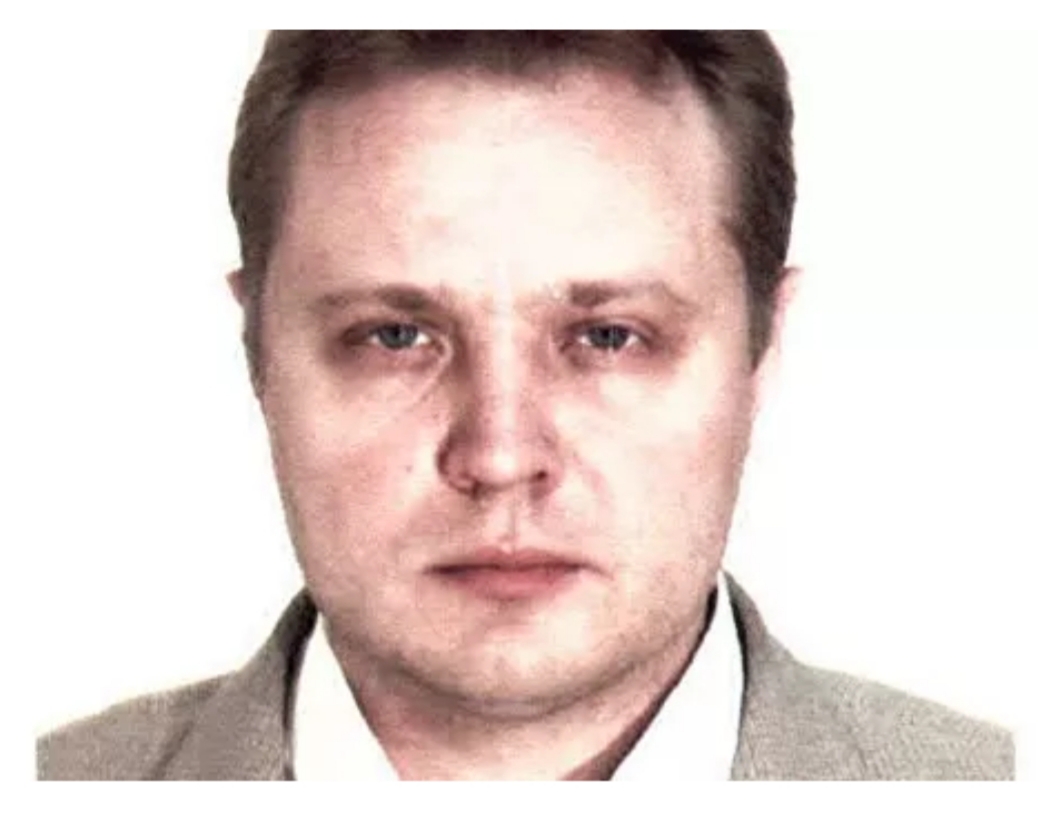


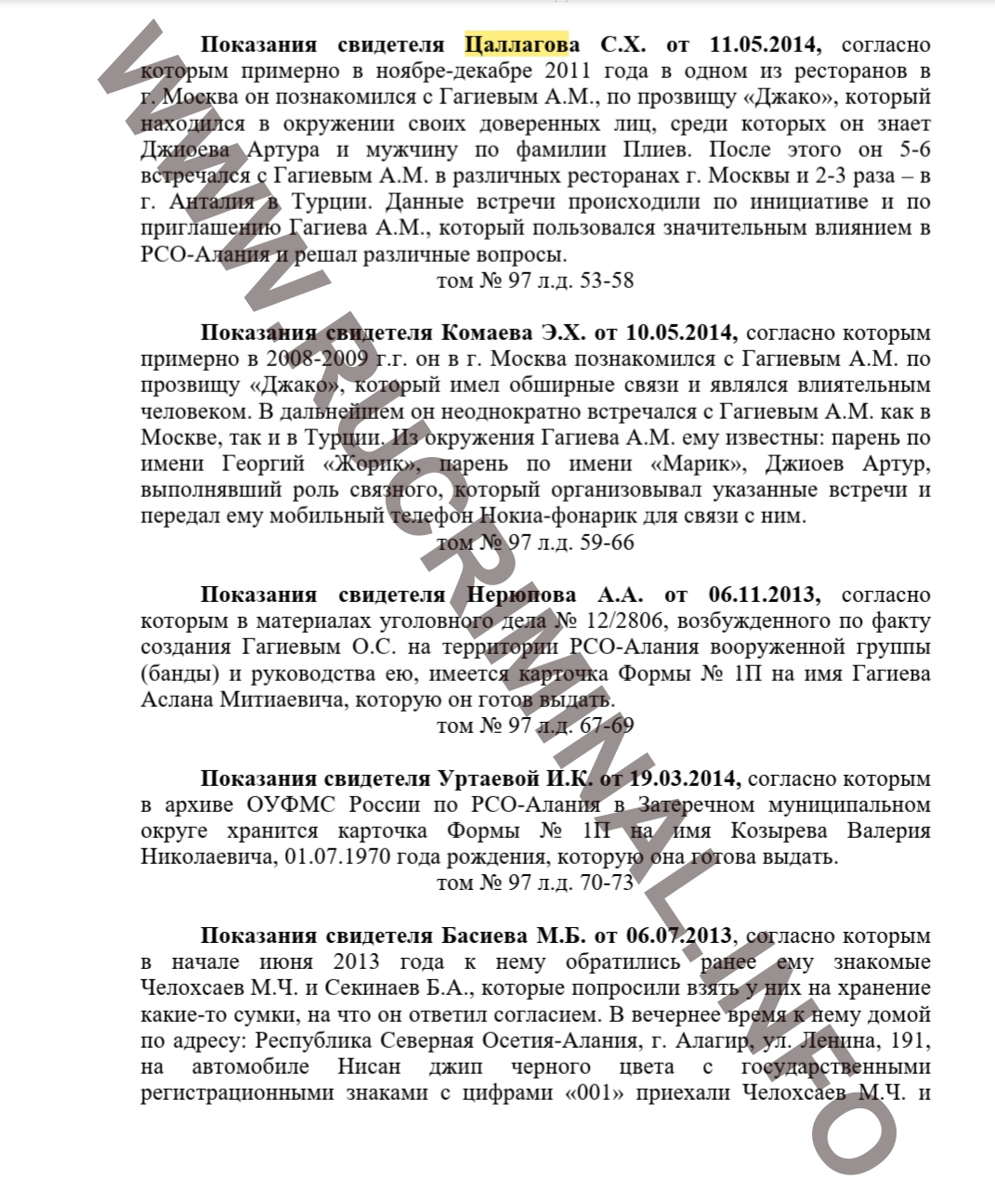
Gagiev himself does not testify against Shvetsova. The charges are based, among other things, on the testimony of one of the gang members who was a participant in the crime. Rucriminal.info cites testimony from members of Jaco's gang about how Shvetsova discussed the problem with Leonov with Gagiev and how Jaco instructed to carry out the murder.

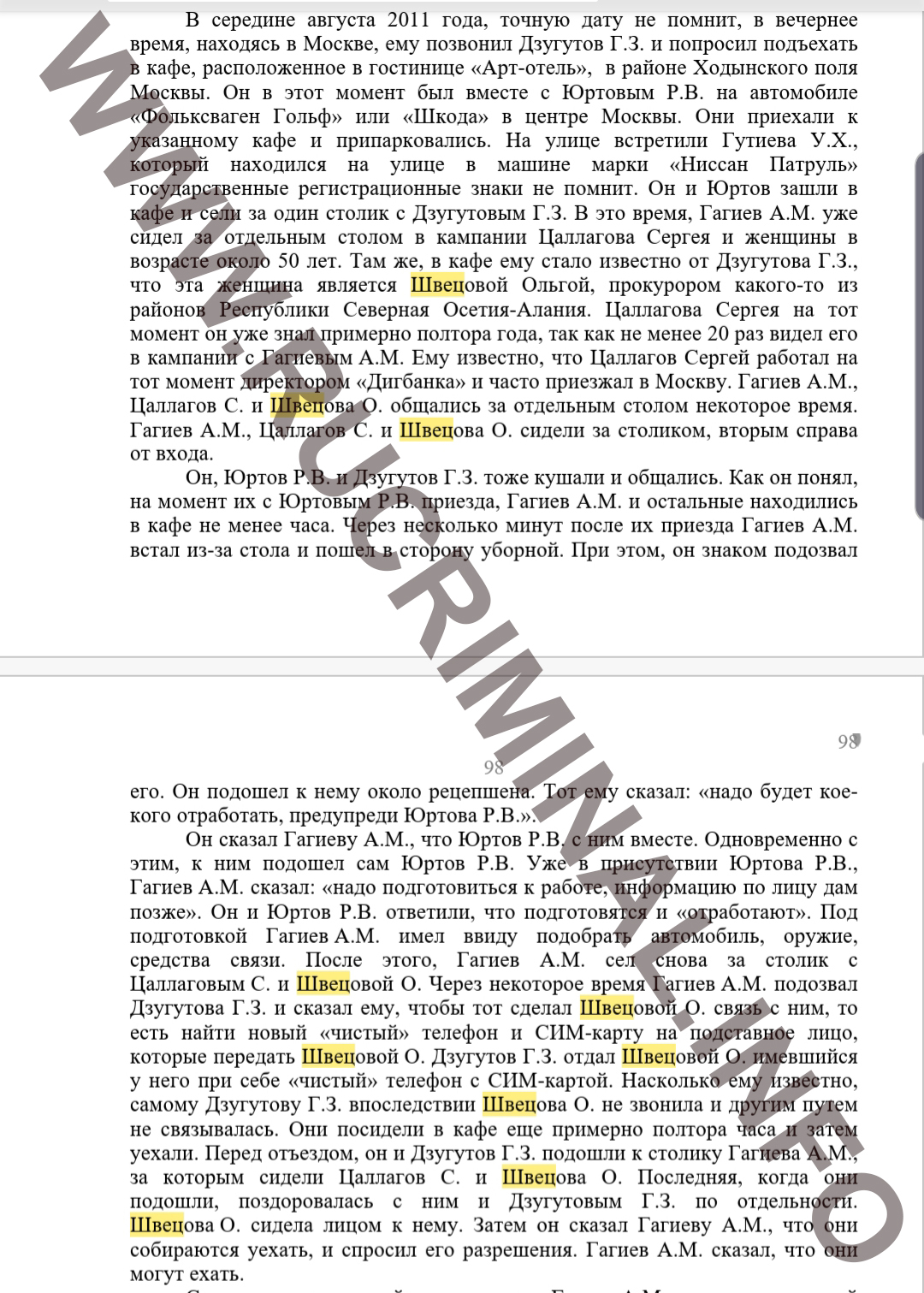
“In mid-August 2011, he does not remember the exact date, in the evening, while in Moscow, Dzugutov GZ called him. and asked to drive up to a cafe located in the Art Hotel, in the Khodynskoye Pole area of ​​Moscow ....

At this time, Gagiev A.M. already sat at a separate table in the campaign of Sergei Tsallagov and a woman about 50 years old. There, in a cafe, he learned from GZ Dzugutov that this woman is Olga Shvetsova, a prosecutor of some of the regions of the Republic of North Ossetia-Alania. At that time, he already knew Sergei Tsallagov for about a year and a half, since he saw him at least 20 times in a campaign with A.M. Gagiev. He knows that Sergei Tsallagov worked at that time as the director of Digbank and often came to Moscow. Gagiev A.M., Tsallagov S. and Shvetsova O. talked at a separate table for some time. A.M. Gagiev, S. Tsallagov and O. Shvetsova were sitting at a table second to the right of the entrance.


He, Yurtov R.V. and Dzugutov G.Z. also ate and talked. As he understood, at the time of them with R.V. Yurtov. arrival, Gagiev A.M. and the rest were in the cafe for at least an hour. A few minutes after their arrival Gagiev A.M. got up from the table and walked towards the restroom. At the same time, he signaled to him. He approached him near the reception desk. The latter told him: "I will have to work someone out, warn R.V. Yurtov.


He told Gagiev A.M. that Yurtov R.The. together with him. At the same time, R.V. Yurtov himself approached them. Already in the presence of R.V. Yurtov, A.M. Gagiev said: "We need to get ready for work, I will give information on the face later." He and Yurtov R.V. they answered that they would prepare and “work out”. Under preparation Gagiev A.M. I meant to pick up a car, weapons, communications. After that, Gagiev A.M. sat down again at a table with S. Tsallagov and O. Shvetsova. After a while, A.M. Gagiev. called Dzugutov G.Z. and told him to make O. Shvetsova a connection with him, that is, to find a new "clean" phone and a SIM card for a figurehead, which to transfer to O. Shvetsova. Dzugutov G.Z. gave Shvetsova O. the "clean" phone with a SIM card he had with him. As far as he knows, Dzugutov himself G.Z. subsequently Shvetsova O. did not call and did not contact in any other way. They sat in the cafe for about an hour and a half and then left. Before leaving, he and Dzugutov G.Z. went to the table of A.M. Gagiev, at which were sitting Tsallagov S. and Shvetsova O. The latter, when they approached, greeted him and Dzugutov G.Z. separately. Shvetsova O. sat facing him. Then he told Gagiev A.M. that they were going to leave and asked his permission. Gagiev A.M. said that they can go, "says the testimony with which Rucriminal.info acquaints readers.

A few days later, he received a call from A.M. Gagiev. to a conspiratorial phone and said that he would be given an envelope with information on the person who was talked about in the cafe during the above conversation. Also Gagiev A.M. said that after receiving the envelope, this person can be immediately "worked out", that is, killed. Four or five days later, he was handed a sealed envelope, unidentified. Who transmitted it, does not remember. The envelope contained a photograph of a face and an address, which he no longer remembers, in the area of ​​the stadium and the Dynamo metro station. The photograph was in color, with a glossy finish, approximately 9x12 cm in size. The photograph showed an image of a man. Subsequently, he learned from the news on TV that his last name was Leonov. Having received the envelope, he and R.V. Yurtov. began tracking, in order to find out the routes and time of Leonov's movements. He connected Gutiev U.Kh. to the surveillance. and Omarova A.S. At the suggestion of R.V. Yurtov, he also attracted E.I. Yashkin to the surveillance.


In the next two weeks, he, Yurtov R.V., Gutiev U.Kh., Omarov A.S. and Yashkin E.I. were engaged in surveillance. They were put up one by one near the address, which was given to them in an envelope. At least 14 days alternately stood near the said house, but Leonov never showed up. In the same period, about a week after the start of the surveillance, he contacted A.M. Gagiev on a secret phone. and said that Leonov did not appear at the address they were given. Gagiev A.S. replied that he would try to find out the reason. After about a week, Gagiev A.M. I called him and said that there was no other address, but clarified that Leonov had contacted some judge, with whom he could live. During the conversation Gagiev A.M. said that the order for the murder of Leonov was made by O. Shvetsova, who was sitting with him and S. Tsallagov in a cafe at the Art Hotel. According to A.M. Gagiev Leonov did some harm to O. Shvetsova's sister, who lived and worked in Moscow. Two weeks after the start of the surveillance of the said house, a white Peugeot car driven by Leonov drove into the yard. At that moment, he and R.V. Yurtov were monitoring the house. R.V. Yurtov identified Leonov. They decided to continue monitoring the car. After about 20 minutes Leonov got into a Peugeot car and drove away from the house. He and Yurtov R.V. followed by a motorcycle. Leonov drove to one of the district courts in Moscow, in the area of ​​st. Forest Moscow. There he parked and sat in the car. Then a woman got into his car, and the two of them drove to the Krylatskoye district of Moscow, on st. Krylatsky hills. Upon arrival, Leonov and this woman entered an apartment building on the street. Krylatsky hills. He and Yurtov R.V. have remembered this house. After that he reported this new address to A.Kh. Gutiev, A.S. Omarov. and Yashkina E.I. For several days, the guys were monitoring this new house and found out that Leonov lives there and regularly arrives there in a Peugeot car.


After that he and Yurtov R.V. decided to carry out their murder plan. To this end, he instructed Gutiev U.Kh. become at the entrance to the Krylatsky hills area from the Zvenigorod highway. R.V. Yurtov he himself determined the place where Yashkina E.I. In the tasks of Gutiev U.Kh. and Yashkina E.I. it was included to inform him and R.V. Yurtov. by means of a radio station about Leonov's passage in a Peugeot car past them, that is, they coordinated them. They used the Vertex radio stations, as far as he can remember. The place of the murder he and Yurtov R.V. chose a parking place in front of the house on the street. Krylatsky hills of Moscow.


In mid-September 2011, he does not remember the exact date; in the evening, he and R.V. Yurtov. on a foreign-made motorcycle under his control, we drove to the house on the street. Krylatsky hills. They stood at the entrance to the courtyard of Leonov's house. Yurtov R.V. with him was a pistol with a silencer, similar to the PM pistol, which he had taken at the Ramenki-1 SNT in his dacha near Moscow. After some time Leonov arrived in a Peugeot car. He told U.Kh. Gutiev by radio. and Yashkin E.I., that Leonov appeared, and they can leave their places. When Leonov drove into the yard and drove to the parking lot, Yurtov R.V. immediately went in that direction. From where he stood on the motorcycle, Leonov's Peugeot car was not visible in the parking lot. After about a minute Yurtov R.V. returned. He got on the back of the motorcycle and said, "we're done, let's go." He realized that Leonov had been killed, and they drove off. They drove out of town, drove to the Moscow Ring Road, arrived at the dacha in "Ramenka-1", where RA Bagaev, II Zasseev, GG Slonov lived. and Kudziev T.M. There, Yurtov R.V. had to get rid of the gun. Upon arrival, Yurtov R.V. he told him that he had shot at Leonov at the moment when he wanted to get something out of the Peugeot car. Also Yurtov R.V. said that there was a woman in the car with Leonov. From the dacha in Ramenki, he and Yurtov R.V. left by car, leaving the motorcycle at the dacha. The next day, he arrived at the dacha in Ramenka, where A.M. Gagiev was staying. He reported to him that his order had been fulfilled and told the circumstances of Leonov's murder "


“No later than 01.09.2012, the exact date and time have not been established, the head of the criminal community Gagiev A.M. an order was given to the head of the structural unit of the criminal organization - the gang Dzhioev A.B. about the commission of the murder of A.S. Leonov

During this period, Dzhioev A.B. informed about the direction of the head of the criminal community Gagiev A.M. about the commission of the murder of A.S. Leonov the members of the gang led by him, which is a structural subdivision of the criminal community, Yashkin E.I., Yurtov R.V., as well as active members of the criminal organization Omarov A.S. and Gutiev U.Kh., who gave their voluntary consent to participate in the upcoming crime.

Being the head of the structural unit of the criminal community and at the same time the organizer of the crime, Dzhioev A.B. developed a plan to commit the murder and distributed the roles between the accomplices in the upcoming crime, according to which Dzhioev A.B. retained control over the execution of parts of the criminal plan, surveillance of A.S. Leonov. and delivery of R.V. Yurtov to the crime scene, who was entrusted with taking part in the surveillance of A.S. Leonov, as well as direct production of shots at him from firearms. Also Dzhioev A.B. entrusting Yashkina E.I., Omarov A.S. and Gutiev U.Kh. to spy on A.S. Leonov, to report on his movements by means of a secret connection and in any other way to facilitate the implementation of the criminal plan.

Carrying out preparatory measures for the upcoming murder of A.S. Leonov, in the period from 09/01/2012 to 09/10/2012, approximately 6 times, in the morning and evening, Yashkin E.I. and R.V. Yurtov, in an unidentified Honda Accord, stood in different places near the house at the place of residence of A.S. Leonov, at the address: Moscow, st. Krylatskie Hills, house no. 36, building no. 1 and observed the said house in order to determine whether AS Leonov lived there.

In turn, in the same period of time, Dzhioev A.B., Omarov A.S. and Gutiev U.Kh., on an unidentified Volkswagen Golf car, as well as an unidentified foreign-made motorcycle, were tracking Leonov A.S.

In view of the fact that during the specified time, Yashkin E.AND. and Yurtov R.V. failed to identify A.S. Leonov, further surveillance of the house began to be carried out by A. B. Dzhioev. and R.V. Yurtov, on an unidentified foreign motorcycle.

In the period from 09.09.2012 to 12.09.2012, Yurtov R.V. together with Dzhioevym AB, on an unidentified motorcycle of foreign production, under the control of the latter, arrived at the household located at plots No. 109, 111, 112, 113, 114 at the address: Moscow region, Odintsovo district, pos. Summer vacation, SNT "Ramenka-1", where Yurtov R.V. took an unidentified Baikal pistol of 9 mm caliber, equipped with a device for silent shooting and loaded with at least 5 rounds of ammunition. After that, Yurtov R.V., with the aim of using in the upcoming murder, carried out illegal carrying of the specified weapon.

As a result of the surveillance, Dzhioev A.B., identified the place of the crime - the courtyard of the house, at the address: Moscow, st. Krylatsky hills, house number 36, building number 1, in which Leonov A.S. lived, and in time - 09/12/2012, when Leonov A.S., together with his wife, will return home.

On behalf of Dzhioev A.B., who acted in pursuance of the instructions of the head of the criminal community Gagiev A.M., Yashkin E.I., together with Omarov A.S. began to monitor the road in the area of ​​the Savelovsky District Court of Moscow, located on the street. Butyrskiy Val, 7, Moscow, where Leonov's wife A.S. worked. - Adamova T.Yu. in order to inform A.B. Dzhioev by means of a radio station. about the movement of A.S. Leonov home. For a similar purpose, on the route from the Savelovsky District Court of Moscow to the house of A.S. Leonov, on behalf of A. Dzhioev, there was U.Kh. Gutiev, also equipped with a radio station for secret communication with the rest of the accomplices in the crime.

12.09.2012, no later than 6 pm, Yashkin E.I. and A.S. Omarov, in an unidentified Honda Accord, stood in front of the building No. 5 on the street. Butyrskiy Val in Moscow, about 50 meters from the Savelovskiy District Court of Moscow.

On the same day, at about 21 o'clock, when the Peugeot car, driven by AS Leonov, drove away from the building of the said court and drove in the direction of the house, past Yashkina E.I. and Omarova A.S., they, through a portable radio station, reported this to Dzhioev A.B.

In turn, Gutiev U.Kh., who was on the route of A.S. Leonov, realizing his part of the criminal plan, informed A.B. Dzhioev, about the movement of A.S. Leonov's car. towards the house of the latter.

On the same day, 09/12/2012, in the period from 19 hours 30 minutes to 22 hours 00 minutes, Yurtov R.V., acting as part of a criminal community, at the direction of its leader A.M. Gagiev, together with A. B., on an unidentified foreign motorcycle under the control of the latter, armed with the above-mentioned firearms, arrived in the courtyard of an apartment building at the place of residence of A.S. Leonov, where he was expecting the latter, with the intent of killing him.

09/12/2012, in the period from 22 hours 00 minutes to 23 hours 00 minutes, when the car "Peugeot" drove into the courtyard of the house at the address: Moscow, st. Krylatskie hills, house number 36, building number 1, parked there and Leonov AS got out of it. and Adamova T.Yu., about the approach of which his and Dzhioeva A.B. the accomplices of the crime Yashkin E.I., Omarov A.S. warned in advance. and Gutiev U.Kh., Yurtov R.V., fulfilling the role assigned to him in the crime, approached A.S. Leonov, using an unidentified Baikal pistol of 9 mm caliber, equipped with a device for silent shooting and equipped with ammunition, made in Leonov A.S. at least 5 shots, causing the latter to have gunshot wounds, from which he died at the scene of the crime. "


To be continued

Arseny Dronov

Source: www.rucriminal.info